Education has purpose but faces huge challenges!

purposed-badgeI am not due to write my contribution to the #500words campaign for purpos/ed until Tuesday 8th March. However, I have woken this morning still thoroughly energised by last night’s #ukedchat special – hosted by one of the founders of purpos/ed – Doug Belshaw. As such, I felt that I should share a few thoughts here and now, lest they be forgotten amongst the myriad of ideas and notions swirling around my brain.

To paraphrase what I wrote on Doug’s blog last night after the discussion – one of my concerns about the state of education is that not enough people actually stand up and take action. They are happy (or not) to sit in the staffroom grumbling about the current governments stance; or to bemoan the limits of the curriculum; or feel that standards are slipping, yada, yada, yada. But they are not ready and willing to do something about it. And I don’t mean do something about it in the ‘take to the streets’ and ‘march on whitehall’, do something about it. I mean stand up and raise these issues with SLT; speak to the principal, parents, governors about how they believe education should be; ignore the heard and do something different in the classroom; have the conviction to believe in what you say in the staffroom and go and do something about it.

I do not believe that it was at all surprising to any of us involved in the discussion on #ukedchat last night that we are not happy with the state of education; that we feel the current government’s idea of what “good education” is does not fit with our own beliefs; or that most of us felt learning should be more student centred. I mean come on, most of us involved in the debate are edupunks – we break the mould everyday, whether its David Mitchell leading the Primary blogging revolution or Dawn Hallybone evangelising about the merits of games based learning. Of course we care, of course we’re engaged, of course we will stand up but that’s because we have been doing so for some time now.

We need to mobilise the educators who are not like us; who are, perhaps, more afraid than we are. Those educators who share similar beliefs and values but perhaps do not have the skills or the guts to go against the grain. Maybe they are an NQT and don’t want to be seen as an upstart still considered ‘wet behind the ears’; or maybe they are a veteran who doesn’t blog, tweet or Facebook and so feel that their voice will not be heard. How do we give these people the courage and means to be heard? To do something different? To challenge the status quo?

This purpose, this debate, this mission is bigger than those of us who are standing square and tall; spitting in the face of traditional Victorian education. It is about each and every child, parent, educator who faces many more years of a curriculum/education that is not fit for purpose; that is not forward thinking; that will not facilitate the sort of learning that will open doors for people. Instead it is closing them, firmly shut. How do we motivate young people to see education as something to be valued and something that is theirs not ours? How can we help them to claim it for themselves? How do we get parents to understand that education is about much more than grades and a getting a job ‘when the learning is over’? These are huge challenges; huge purposes that need to be addressed if the engagement and passion on display last night is to be turned into more than rhetoric.

What binds us all is the belief that education does have a purpose (although this is different for everyone) but in 2011, more than ever, it faces huge challenges.

686 words! Gah! How I am going to stick to 500 words, I have no idea?!? However, you will be able to read more about what I believe the purpose of education is on Tuesday 8th March, right here on James Michie “…a 21st Century Educator”.

#edjournal: available to download – NOW!

I am pleased to announce that after a successful online launch of #edjournal, the PDF edition is now live and available to download. You can download it from the site or direct from here. An EPUB version is still in the works but the process is not as straight forward as I had assumed. However, I will persevere and make it available as soon as I can.

Over on the site, I have added the Disqus commenting system to article pages so that readers can add opinions and ideas. We really want to generate discussion around the articles that we publish, so if after reading you feel inspired, please leave a comment. You could ask a question of the author, offer further ideas or start a debate. In the process of doing this I learned how to create my own Google gadget.

There is also now an #edjournal Twitter account. Please follow us at @_edjournal to keep up to date.

Or you can subscribe to the site feed over on the homepage or by clicking here.

Nick and I hope that you enjoy reading #edjournal in its intended format. Comments, ideas, constructive criticism are welcome as usual!

Gove + Zuckerberg = Elitist Victorian Education 101

Mark ZuckerbergThis past week, education secretary Michael Gove suggested that he wants a national curriculum that will create the next Mark Zuckerberg.

Okay, that’s not quite what he said. If that had been what he’d said, I might not have bothered to write this post, as surely that would have implied a curriculum that was creative, fostered ingenuity and was embracing of new technologies. What the education secretary actually said was:

“When Zuckerberg applied to college he was asked what languages he could speak and write – as well as English – he listed, French, Hebrew, Latin and Ancient Greek. He also studied maths and science at school. He would have done very well in our English baccalaureate. And the breakthroughs his rigorously academic education helped create are now providing new opportunities for billions.” (guardian.co.uk, 2011)

Now, I’ve got no problem with Mark Zuckerberg. He created a website that has revolutionised social networking; he’s an astute guy, working alongside some brilliant individuals who have helped him to grow his creation into a billion dollar company; and from what I can tell, he is not actually the complete a**hole that the book: ‘The Accidental Billionaires‘ and the film: ‘The Social Network‘ would have you believe him to be. However, I do not believe that the fact that he can speak and write “French, Hebrew, Latin and Ancient Greek” or that he “studied maths and science at school” had anything to do with his success. I’m fairly certain that his study of IT had a significantly large part to play in it. That, coupled with a healthy dose of ingenuity (not a subject on the national curriculum) and creativity (again not a subject in itself) had a major role in helping him create Facebook.

You see, there are two significant problems with Michael Gove’s thinking. One, there is plenty of proof to suggest that education does not guarantee success. The myriad of entrepreneurs who have been successful ‘sans-education’ is huge. Two, the subjects he refers to as being part of an “academic education” are only a small piece of the puzzle in helping young people to develop the skills they need to survive in the 21st century. The point being, that a student who studies Philosophy, Drama and Art is just as likely to be the next Mark Zuckerberg as a student who studies Maths, IT and Latin.

What I resent is the implication that certain subjects are considered more academic than others. In fact, we should insert the word ‘better’ in place of academic, that is what Michael Gove means after all! This is the sort of elitist thinking that was being steadily eroded during the Labour party’s time in government. It is now being rebuilt by the so-called ‘coalition’, like elitist bricks stuck together with an alarmingly unhealthy dose of cynicism towards new technologies. The curriculum review is a waste of time and tax payers money; nothing more than a placation exercise; as I firmly believe that Michael Gove knows exactly what he wants the national curriculum to look like. In case you haven’t heard, Michael Gove wants lessons to “emphasise the learning of facts”. I think both my own students and Mark Zuckerberg would tell Michael Gove to go shove his lessons where the sun doesn’t shine. After all, he can find out anything he needs to know via Google or by asking any one of the 500 million people who are on Facebook. I’m not suggesting that facts have no place in education but to see them as the basis of an “academic education” is more 19th century than 21st.

It’s time to make our voices heard. One subject is not better or more important than another. We should be offering our students greater choices and freedoms not taking them away. And we should not be considering a return to a Victorian era curriculum that will certainly leave British school children wanting in comparison to their European, American and Asian counterparts. It’s time to take a stand. It’s time for disruption, it’s time for the edupunks to stand up and be counted.

Who’s with me?

—

Image: Jolie O’Dell

3 things I do every (school) day that make me a better teacher

1. Read at least one article/blog post about teaching and learning.

As an English teacher it is probably a little predictable that I read a lot, however I believe that it is important to keep up with what is happening in education. I have also learned as many of us do that teaching is a busy and time consuming affair, therefore I don’t often find extended periods of time to read. Instead, I use a small number of apps and devices to bring reading material to me in a manageable way. This includes Google reader as an RSS aggregator and apps such as Reeder and Instapaper which I access on my MBP and HTC Wildfire respectively. I save and export longer articles/papers to read on my Sony Reader. Without going in to too much detail here, this combination of devices allows me to read at whatever point of the day I am free to or feel like doing so. Hotspots are: on the bus (7:30 – 7:45) heading to work and when school has just ended (3:40 – 4:00).

I am of the mind set that the best teachers are those who not only work hard on their day-to-day classroom teaching but also continue to keep up with pedagogical ideas, theories, new technologies and what other teachers are doing in their classrooms. When I talk to other teachers on Twitter or at conferences they tend to fit in with this description and in turn tend to be innovative in their practice, open to new ideas and are ready to discuss and share their opinion about education. Reading, for me, is an integral part of this dialogue. It is important to be informed.

2. Make sure one of my lessons is not teacher directed.

Two issues here. 1. Teaching from the front of the classroom (lecture style) is a sure fire way to kill creativity, learning and can lead very quickly to behavioural issues. 2. Teaching from the front of the classroom is a sure fire way to drain yourself of energy and enthusiasm for what you are teaching. At the beginning of each week I review what I have planned to teach and then set about planning into each of my days a lesson (with a different class each day) where, after sharing the learning intentions and explaining what is to be achieved, I shut up and spend the majority of the lesson sat with my students helping and supporting them with their learning.

I use these lessons in a variety of ways, here are a couple of examples:

  • Targeted support: I will group the class by ability and select a group to work with. During the lesson I will dedicate my time to that group – putting trust in the other students to get on and complete the work unaided. Some of the ways that I ensure the students are engaged in the work is by giving them a choice of what to do, in turn giving them ownership of their learning. I usually also set some sort of feedback exercise (not necessarily with me involved) where they are being relied upon to provide information. This allows me to then focus my time on the students I have decided to offer some more personal support to.
  • Assessment: I believe it is important to assess students work with them so that they can understand the process and what I am looking for. If certain students have been making the same errors repeatedly I will use these non-teacher led lessons to sit with them and will mark their work throughout the lesson with them, almost as a form of 1-2-1 (directed) learning. As they try to tackle the ideas or skills they have been struggling with I can address them and get them to work through, making corrections. This is time consuming and I don’t get around to all of the students in a single lesson but the level of learning and progress that takes place is very high. Over the course of the year every student who needed this level of support will have gotten it.

To some this may not seem completely fair and that some students may not get the same level of personal input from me. However, I do not have a problem with this and even tell my classes at the beginning of the year that some of them will get more out of me than others. What I also explain though is that I am not the fountain of all knowledge, that I will help them to understand where to look for answers so that they can solve problems for themselves. I also explain that for some of them I will simply be a facilitator, for others they will need my knowledge and expertise. They are all starting at different points and the better I know them, the better I can adapt the way that I support them as individuals.

3. Stop and take a break.

I make sure that I use either the 20 minute break time or the 50 minute lunch time each day to stop and switch off from what I have been doing and am going to be doing that day. Where possible I try to do this at lunch however, I teach during lunch time on a Friday. Why do I do this? Becuase, education is my career but it does not define me and I am certainly not going to let it kill me. Teaching is intense. Particularly when you are dedicated. Therefore, it is important to give yourself a mental break. I achieve this in a variety of ways. I may simply sit somewhere in silence; other times I may sit and read or surf the net; and on some occasions I will go sit with others and catch up on the gossip. Whatever, I do I try to make sure that it has nothing to do with school.

To those teachers who say “I simply have no time to take a break”, I say: “you are doing something wrong then!” The most important thing to learn as a teacher is how to do each of the many different tasks that make up your day in both the most effective but least time consuming manner. This could be:

  • using ‘assessment stickers’ that can be filled in with a few letters, numbers or ticks instead of writing out long paragraphs at the end of a student’s work.
  • keeping an electronic mark book instead of a paper one – easily copied for use with other classes.
  • setting extended homework projects that challenge your students but do not require that you are mark homework every couple of days.
  • using peer assessment more often to make your students more critical learners while lightening your marking load.
  • to collaborate with someone else on a scheme of work. You will not have to produce every single resource and your students will benefit from the ideas of two teachers, not just one.

There are many ways to cut down on your workload while ensuring that the learning in your classroom is engaging and effective. Putting just a few of these ideas in to practice would ensure that you have time to take that break. It is important to switch off. After all, you are only human contrary to popular belief! 🙂

Sharing What You Do Online – FTW!

A little under two years ago I had been teaching for six years but had not considered keeping a blog and I wasn’t on Twitter. Both of these outlets have had a significant impact on my teaching and the learning that takes place in my classroom. This morning I was reminded of just how valuable sharing what you do online is.

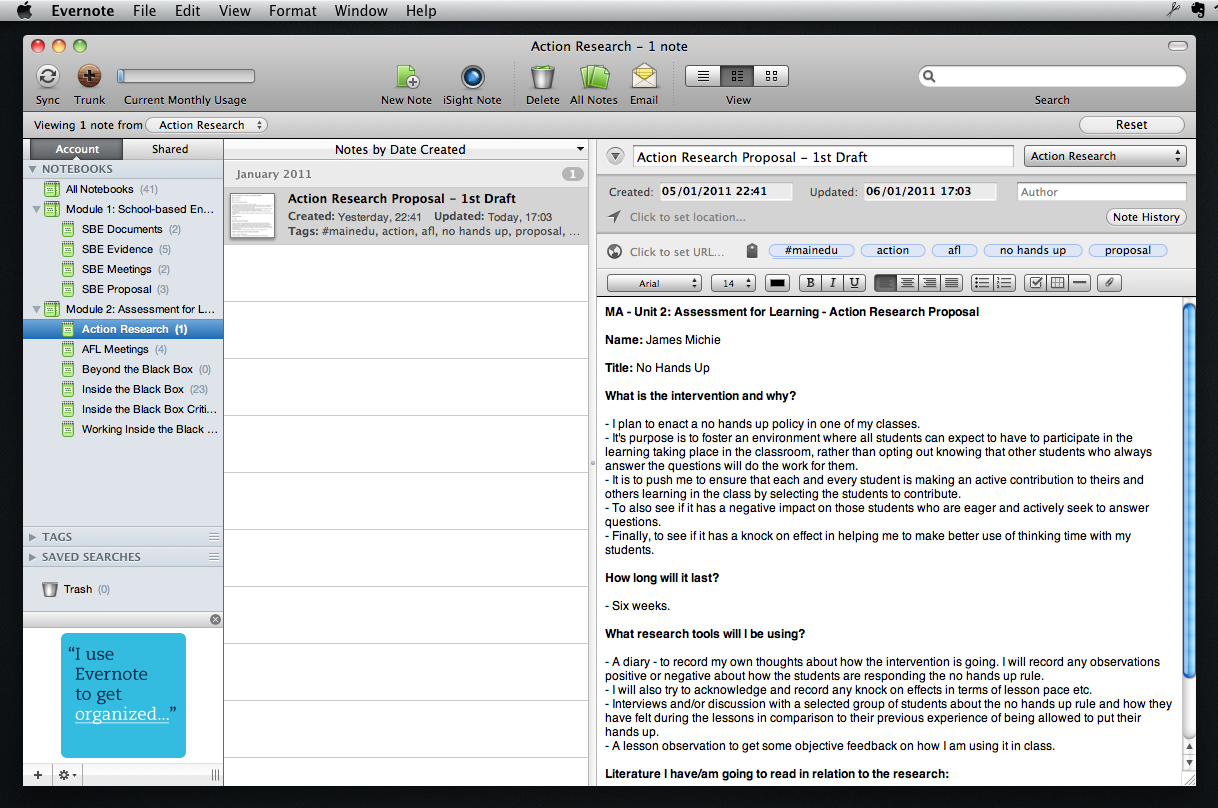
Catching up with tweets during New Years Day, I decided, very much on a whim, to have a go at a #365 project. A 365 project is where you take a photo a day for 365 days. I already had a Posterous blog set up that I had been using for posting photos and thoughts that didn’t really fit on this blog. Therefore, I had to do little more than start adding the photos. Having had a significantly hectic day yesterday, I got home, ate dinner and then, while working on my MA realised that I had not posted a photo for the day. In fact, I had not taken any photos at all during the day and there was nothing on my phone or laptop that I felt like posting. Instead, I decided that I would simply post a screen grab of what I was working on at that moment.

Evernote and MA

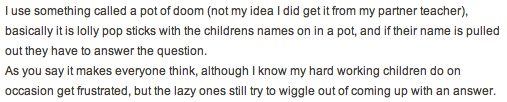
As you can see I am using Evernote to organise my MA. I have folders set up for each module and within those folders I have note books where I have recorded meetings, research proposals, notes on readings etc. I shared this on a whim, more out of ensuring that I kept up with the #365 project than anything else. I didn’t expect anyone to really look closely at the image. But in this I was wrong. If you zoom in on the image you will see that I was working on my ‘Action Research Proposal’ for my ‘Assessment for Learning‘ module. I have decided to put a ‘No Hands Up’ policy in place with two of my classes. This morning, checking my email, I saw that I had a comment from Christine Roberts (@Christiner733). She shared with me how she deals with the idea of ‘no hands up’ in her classroom and also shared her feelings on how her students respond.

365 Comment

What had been for me more a formality of keeping up with my #365 project; an innocuous post which had no intended outcomes, led to the sharing of good practice and ideas. Once again proving that sharing online is valuable.

For those of you who are not into your acronyms – FTW stands for ‘For The Win’ and I believe this to be true of sharing what you do online. Take the time to reflect on the teaching and learning that takes place in your classroom. There is no better way to do this than to write about it – IMO! Blogging is so simple, particularly with platforms such as Tumblr and Posterous that require almost no set up or web expertise to get started. And join Twitter, there are a plethora of talented and genuinely nice people out there who are willing to share ideas and help you grow as an educator.

In these tough financial times, the sharing of ideas and resources online may just well be the best way forward…