Having begun the MA in Education, promising to blog my learning journey, I have found that time has been at a premium and thus blog posts have been in short supply. With that in mind, I have squared away a moment or two to provide an update.
While I may be finished with the module, AfL remains an area of significant interest to me. Particularly, because of the way that I have been using Google Docs with my students. Moreover, this is the focus of my School Based Enquiry, for which I continue to collect data.
Based on the feedback I received from my Module 2 tutor, I am planning a trip to Oxford Brookes University Library over the half term break to expand my reading; there are some texts that look useful but I am struggling to find in PDF format online.
Module 3: Developing eLearning began earlier this month. This module will likely prove to be the most enjoyable of the three. As an area of education that I am significantly immersed in, I hope that it will afford me the opportunity to broaden my understanding and refine some of my current practices.
In order to ensure that I don’t simply fall back on tried and tested tools however, I completed an audit of the technologies that are embedded in my current teaching practice and those that are not. It is my intention to develop a series of lessons wherein one of these technologies will be used to facilitate the learning in some way.
Reading for the module has also commenced and for me a number of the texts are old news but nevertheless I will revisit them, making the necessary notes in Evernote to use later in my assignment. We have been given the already well critiqued Prensky articles: ‘Digital Natives, Digital Immigrants’ and ‘Do They Really Think Differently?’ (Digital Natives: Part 2) to read. For some up to date debate on the concept of digital natives, these posts from Simon Bostock and Doug Belshaw are definitely worth checking out:
Finally, I hope that as the unit eveolves I will get the chance to tie in some of the material I have been reading and writing about recently with regards to learning technologies, taxonomies and literacies. Only time will tell.
If you watched episode one of Wonders of the Universe you will have a basic understanding of entropy and the arrow of time. If you didn’t see it, watch this clip:
I found this fascinating and began to think about how entropy relates to learning and education.
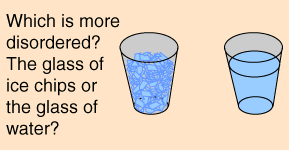
It seems to me that many of us, involved in education, are constantly fighting against the arrow of time seeking to create ordered systems (ice cubes) with low amounts of entropy. However, the science would suggest that structures with low degrees of entropy are unsustainable; that they will eventually reach a higher state of entropy (water) over time.
If this is the case, would we not be better off embracing a less structured system of education, one in which there is a high level of entropy already. The way that I learn now (as an adult) through multiple feeds and sources of information is far less structured than the 5 lessons per day, two homework per night model that I experienced in school. I would argue that it is far more richer as the widening of sources of information are changeable and in some senses exponential. If this is, as I suspect it is for many others, the natural model of education after school then why not make it the method of education during school years?
The problem with a system of education that has a high level of entropy would be accountability. However, this is where I believe education, today, has gone wrong, particularly in the UK. We could embrace a less structured system of education if accountability rested with the learner rather than the educator. League tables and Ofsted force rigidity and structure upon us leading to spoon feeding, content driven curricula and mediocrity for many learners. If the accountability was with the learner, there would inevitably be an increase in failure (in academic terms) but I believe there would also be a significant increase in engagement and success. If we gave students, along with the accountability, the freedom and responsibility to define their own curriculum, their own learning paths, I believe they would flourish.
For this to work it would require many different learning models, sources and structures. The entropy would be high but arguably more sustainable and increasingly more likely to bear fruit. Why? Because it acknowledges the arrow of time and embraces change rather than continuing to try to shore up an antiquated education system; stuck in the past.
What do you think? Is it time for education to embrace entropy?
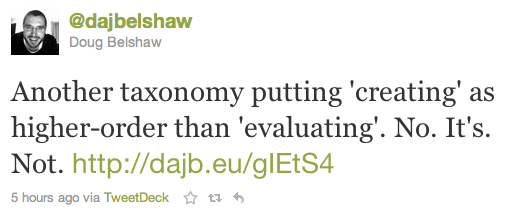
While I do agree that ‘creating’ does not belong above evaluation and that there is room for some revsion of Bloom’s Taxonomy, I do believe that ‘creating’ is a cognitive skill. In fact, I believe that it should be an integral part of all learning taxonomies; that you can’t be fully literate until you have created something.
You can’t create something without some prior knowledge. It is from this knowledge that you can make decisions and by it’s very nature ‘decision making’ is a cognitive skill. Moreover, all creation is a result of our experiences. Arguably, there is no originality in creation any way (Strinati, 1997). When we create we make both conscious decisions and unconscious decisions, based on our learned experiences.
To take Doug’s son creating his first piece of art as an example: Yes he can paint a picture without having learned to analyse, synthesise (consciously) or evaluate. However, his behaviour is not ‘original’, it is learned and is born out of memory, therefore he is replicating learned behaviour. The way he holds the brush, the choice of colours and so on, all represent decisions, some more conscious than others, but decisions none the less and therefore show a cognitive process in action.
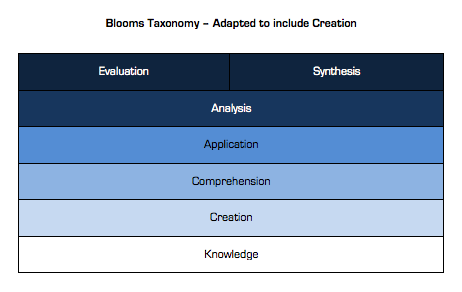
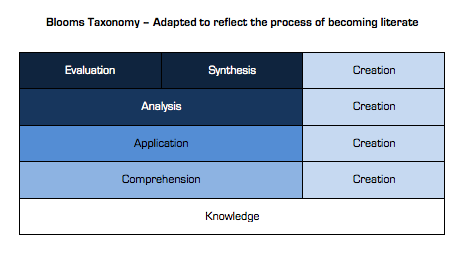
I think that the SOLO Taxonomy that Doug referenced actually comes close to acknowledging ‘creating’ in its more rightful place. In this taxonomy the phrase ‘Do simple procedures’ is used right near the beginning and I would argue that ‘simple procedures’ can be interpreted as ‘creating’. If I were to adapt Bloom’s Taxonomy to incorporate creation, I would suggest something like this.
As you can see I also partly agree with Doug about the placement of Synthesis being wrong although I would see it as equal to evaluation. As cognitive processes the two directly effect each other. Your ability to synthesise something is often based on your judgement but your judgement can be altered as you synthesise something.
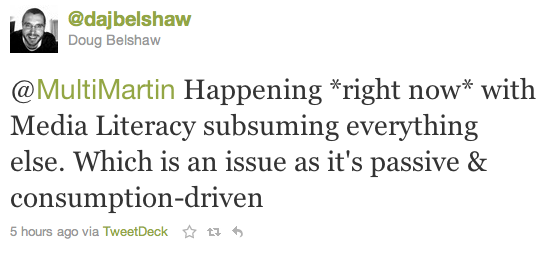
My initial involvement in this debate arose after Doug tweeted this:
Rather than this one that started the debate in the first place:
I include this as I think that it reveals a key feature of my thinking in this debate. I don’t believe that Media Literacy is neither ‘passive’ nor is it ‘consumption driven’. To be ‘Media-literate’ you need to have created your own Media.
I have had many conversations in my time with colleagues about the merits and drawbacks of coursework in the Media Studies syllabus. I always come back to this: Can students truly understand the Media if they don’t create it for themselves? They already do in their daily lives but I want them to create texts more critically. I want them to unpack that process of creation. This undoubtedly improves their skills of analysis and their ability to evaluate.
After all, you wouldn’t teach Maths by having students read the sums and then the answers; you make them work through the problems, learning how to solve them for themselves. You wouldn’t teach students to play football by doing nothing more than watching Manchester United on the TV. Without the doing (the ‘creating’) the learning is meaningless.
So perhaps Blooms should look more like this with creation featuring alongside every stage of the taxonomy, after knowledge. As ‘creating’ as a cognitive skills is imperative on the path to becoming literate.
My thesis: You can’t be literate if you have never created. To be fully literate you need to create throughout your learning journey, only then will you be able to make meaningful judgements based upon fully informed analysis. Creation can help you piece it all together, what’s more cognitive than that?
This post is the second in a four two part series, you can read part one here. Having set out a case for social networks in place of VLEs in part one, one of my other criticisms of learning platforms is that many of the tools they come pre-loaded with are simply not up to scratch when compared to the myriad of tools freely available on the World Wide Web.
Collaboration (and a healthy dose of assessment for learning)
Google Docs does collaboration effortlessly and in genuine ‘real time’. This makes it far more powerful than its competitors. I spent more than two years wrestling with the wiki module in Moodle before I made the move to Google Docs. I have never looked back since. The fact is that real time collaboration is far more meaningful for students. They feel empowered by the fact that they can make instant changes instead of having to wait in turn. This has been my main criticism of Moodle, many of the tools lack the instancy that I and my students have come to expect, particularly when it is available in other tools on the Web. I can’t speak to what Diipo will offer in this area but as an avid Google Docs user I can’t see it making me want to switch.
What’s more, as I have already chronicled on this blog, Google Docs offers excellent opportunities for assessment for learning. I use it on almost a weekly basis to develop my students’ peer and self-asasessment skills. I also try to assess as much work as possible using it at the formative stages. My students really enjoy using it.
Oliver Quinlan has also blogged about his use of Google Docs for collaborative assessment. In his concluding comments he discusses the notion of students developing their own workflows. This is an interesting concept, which I insert here, because I have had similar experiences. The wiki module in Moodle is quite cumbersome and in actuality rather than promoting collaboration, inhibits it. Google Docs offers multiple ways for students to collaborate, discuss and edit their work including a simple back channel. My students have thrived using Google Docs and I have found myself rethinking the way I plan these sorts of activities, trying to allow them to tread their own path.
As for security, there is little to be concerned about here. Documents are private by default and can be shared and unshared at the author’s discretion. One of the first things that I discuss with my students is the benefits and potential hazards of sharing information with others, particularly publicly. The benefits of sharing documents though are clear and I can’t think of one collaborative tool offered within a VLE that could generate or reproduce the level of creativity displayed in this video:
A range of apps with infinite possibilities
There are a whole bunch of other useful Google tools that your students can harness via the World Wide Web that won’t be found inside Diipo or Moodle. Lets start with the cornerstone of the web: Search. While some will argue that as the teacher I should curate resources for my students, which I could link to from within the VLE, I would rather teach them to make better use of Google’s excellent search engine. Rather than me trying to write about it, hop on over to Ian Addison’s blog and let him show you some of the hidden tools that can make Google search a highly valuable experience for learners.
Another tool that Google offers is Maps. For this one I’ll let Tom Barrett’s blog do the talking. He made excellent use of it during all that snow we experienced last year.
Nearly all Google apps (Scholar, Books, Earth, YouTube) offer valuable learning opportunities but none are tied down within a learning platform. They are free and available online. The only thing that will stop you using them is your imagination and possibly your schools internet service provider (you might have to get them unblocked). Every Google app I have used with my students has worked well, I can’t say the same for some of the tools I have tried in Moodle.
If you want to get more out of using Google apps with your students you should definitely check out Richard Byrne’s guides and tutorials on his blog. Or check out the excellent range of teaching ideas for Google Search, Docs, Forms, Maps and Earth from Tom Barrett’s Interesting Ways series.
It’s not all about Google though, there are many other apps out there that are worth using with your students. One I use a lot is Lino it. Lino allows you to add sticky notes to a canvas. It is great for starters, plenaries, homework. I can begin a discussion with it in one lesson and then re-use it for homework the next. The principal of mind-mapping or generating ideas could be done in a forum on Moodle I guess but it can’t be re-ordered afterwards, it can be reused in half as many ways. I have written about Lino in more detail here.
In a recent Moodle training session I delivered I used Lino to get feedback at the end. The 16 teachers who attended were more wowed by Lino than they had been by everything we had covered in Moodle. I wonder if its because it took them less than two minutes to figure it out. Shouldn’t VLEs be that easy?
Another fantastic tool is Voicethread. It allows you and your students to comment on text, audio and video, giving you something that can be referred back to later and, like Google Docs, is fantastic for formative assessment. Check out what David Mitchell and his Year 6 class have been doing with it at Heathfields.
Is a learning platform necessary?
I can already see that one of the responses levied at me will be: “Having a VLE doesn’t mean you can’t make use of these tools, you can link to them or embed them within it.” However, the notion of adding or embedding links within a VLE makes me ask: Is the VLE necessary at all? If I’m going to go outside of the VLE to find tools that I actually want to use and believe that my students will enjoy, can’t I curate those on a well managed website or a blog. Why do I need to invest in VLE to do that?
And in the current climate, with funding in education being the way it is, would I not be better off encouraging staff to take a pick n’ mix approach to IT based tools rather than buying into a heavy duty content management system that needs to be paid for (there are servers that need to be maintained after all) and having to employ someone to look after it? When that person is let go because the school can’t afford to pay them anymore, who is going to help fix broken VLE pages or modules? If Google Docs has a problem there are a whole team at Google who will sort it out and it won’t cost the school a penny.
Natalie Laferty responding to part 1 of this series on Twitter yesterday shared this post with me. Two students, at the University of Pennsylvania, created their own learning platform in response to their dislike of Blackboard, describing it as: “overloaded with features and dreadfully designed, making simple tasks difficult”. Perhaps, that is part of the problem; VLEs are suffering from ‘feature bloat’. If they were stripped back they might have more of a purpose.
In part three: blogging, file sharing and the importance of the hyperlink.