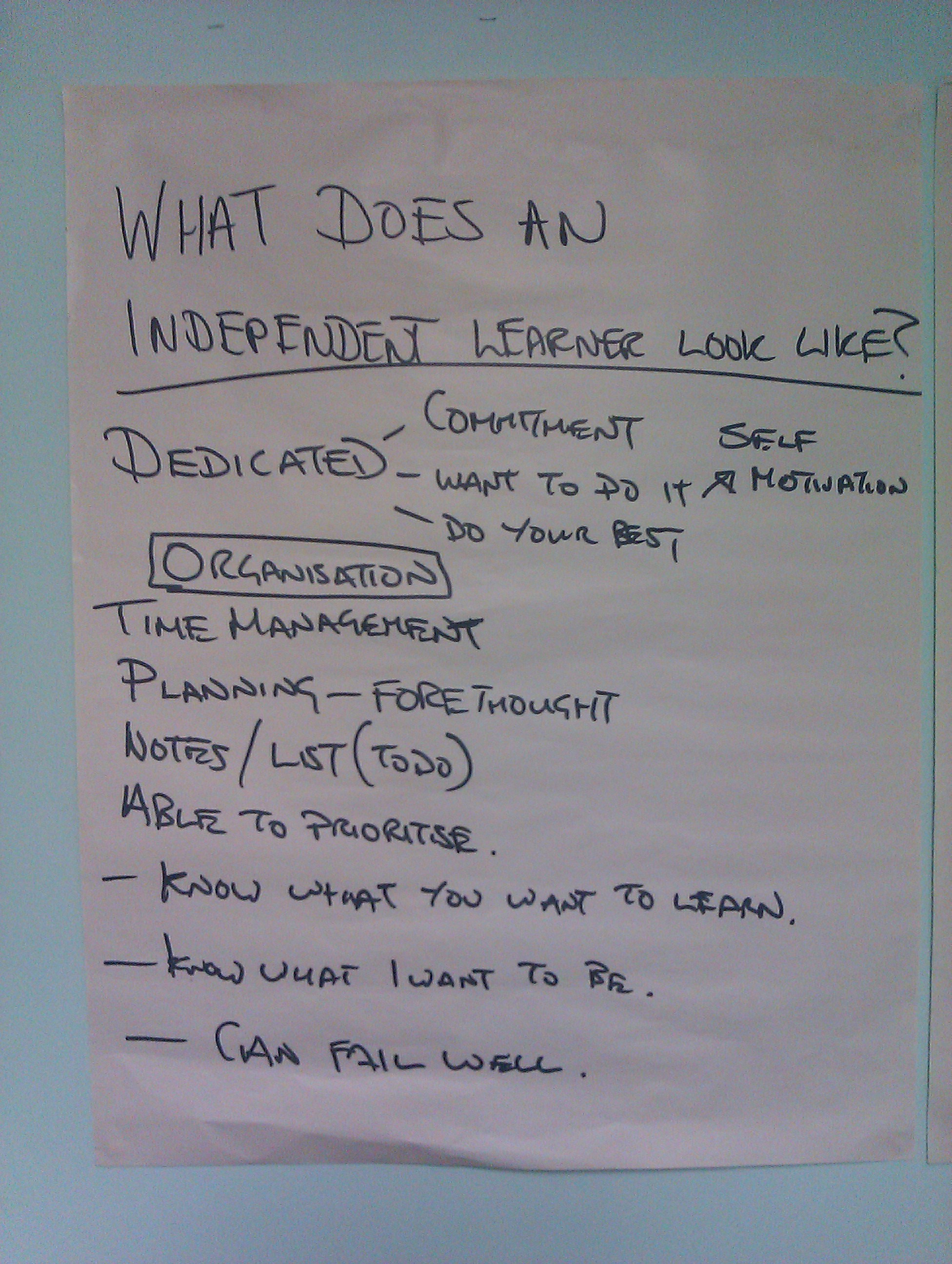
Yesterday, I asked my Y12 Media students what attirubutes and skills they feel makes an effective independent learner. This is what they came up with; much of which was echoed by those of us who were involved in #ukedchat last night.

I have the distinct pleasure of hosting #ukedchat this evening.
The poll is closed and the winning question is:
“Can we really help our students to become independent learners or are there too many constraints?”
In order to address this question effectively, I wish to begin by considering first what is meant by ‘Independent Learning’? What does an ‘independent learner’ look like? One of the strengths of #ukedchat is that the educators who get involved represent a diverse cross-section of the education landscape; from KS1 all the way up to HE. I’m sure that we will all have different perspectives on what an ‘independent learner’ is.
I then wish to address the winning question and consider if it is possible to help the students in our classrooms to become independent learners.
I hope that you will be able to join in with this evening’s discussion – proceedings get underway at 8pm on Twitter. If you’ve never taken part in #ukedchat before, there is advice here on the best ways to get started.
[Update: Saturday, 15 October] This was the 67th instalment of #ukedchat. You can read a summary of the discussion here and download a PDF archive of all the tweets here.
HD video cameras are ubiquitous and cheap, there is no excuse.
Capture. Watch. Reflect and Evaluate. Improve.
Having spent more than a year improving my personal productivity, I can sum up what I’ve learned in a single sentence: “Pick one task and do it”. However, that would do a disservice to the journey and to the great people who helped me along the way through their writing on the subject. So, without wishing to encourage you to spend more time reading about productivity than being productive, here are three books that really helped me reach a place where I can stay focused on doing ‘the work’.
If I had to recommend one book this would be it. It has really made a difference in helping me become more productive. The books’ strength lies in its brevity and the fact the Leo doesn’t over do the GTD stuff. Instead, he focuses on the underlying issues that may be stopping you from doing ‘the work’. It reads well. Eloquent prose, set out in well-structured essays that challenge you to reflect deeply on the way that you prioritise and use your time. Particularly, useful was the focus on changing and replacing habits. By replacing bad habits with useful, more productive ones, I have seen a huge difference in my productivity.
Highlights include:
Keeping It Straight – Patrick Rhone
Patrick is one of my favourite writers on the web and his work translates really well to the structured, thematic nature of a book. Keeping it Straight is Patrick’s first book – a collected set of essays that deal with personal productivity, minimalism, mindfulness and motivation. Again, this is not a long read; perfect for the daily commute or for dipping into when the moment arises. This book is very personal, much of the content gleaned from Patrick’s journal, it adds a level of authenticity that I find is often missing from books of this ilk.
Highlights include:
#uppingyourgame – Doug Belshaw
Doug is a friend who has been fantastically supportive, helping me on my blogging journey. He has also (although he may not have realised it) had a significant impact on my approach to personal productivity. His approach is a pragmatic one and as such he begins by getting to the heart of why we should care about being productive in the first place. This is refreshing, as many productivity related texts assume that the reader already has this figured out. Like the other two books, this is a well structured, well designed text, placing emphasis on the authors voice.
Highlights include:
As I mentioned above, it is easy to spend more time reading about productivity than actually getting on and being productive. However, while I’m on topic, I thought I would share some of the other material that has contributed to my journey. This is not an exclusive list, just a selection of the ones that come to mind as I sit writing this.
Manifesto: Inbox Zero
Idea: five.sentenc.es
Essay: Making the Clackity Noise
Essay: Cranking
Essay: The Noise
Essay: the beauty of the ellipses
Essay: Purpose Your Day: Most Important Task (MIT)
Essay: Do One Thing Well
Essay: How I Became an Early Riser
Essay: How to ‘chapter’ your life to make it more productive
Essay: The hidden power of a gift
Book: Mindfulness in Plain English
Video: Just This
Podcast: Enough: The Minimal Mac Podcast
Podcast: Back to Work
The best piece of advice I have ever been given is this:
Sit back and listen
It is very easy, particularly when you are looking for that first promotion, to feel like you need to constantly make yourself heard. So much so, that you stop listening.
Instead, sit back and listen; giving other people’s views the consideration they deserve.
Some may view the third outcome negatively but I do not. If you take the time to listen before sharing your views, it is easier to shape and change them. Once they are out in the open, it is not as easy to admit you were wrong.
And remember. You can make all the noise you want but if no one is actually listening…
…then it is just noise.