“Open to Work”

❗️ After dedicating six years to The St Leonards Academy as Vice Principal, I have decided that it is time to look for new opportunities. 

⭐️ I am a skilled and motivated educator with 22 years experience in the classroom; most of which have been spent in positions of leadership. I hold a Masters Degree in Education and have continuously worked to develop and improve my knowledge and skills. 

🏆 As a senior leader, I consistently create impact. At The Chalfonts Community College, I lead on raising standards, moving Progress 8 from -0.23 in 2017 to +0.1 in 2019. Most recently (2025), I contributed to improved results at The St Leonards Academy. English Language moved above the national average; while other subjects made significant improvement in the percentage of Grades 9-4, including Science, Geography and Food Tech.

My main areas of strength and expertise are:

  • Educational leadership
  • Strategic thinking and problem solving
  • Professional development and coaching
  • Assessment
  • Curriculum design and innovation
  • Educational technologies

❤️ The area of educational leadership that I am most passionate about is teacher professional development and coaching. Teachers who are valued and nurtured, while being held to account, sit at the heart of successful schools. I lead and support staff with empathy, compassion and integrity; helping them to grow into highly effective teachers. I believe in the power of effective line-management based on structured feedback and coaching, to unlock potential.

🚀 The impact of this approach helped me to be a highly effective ECT Induction Lead and Professional Tutor for ITTs. I worked closely with a wide range of external providers (Ambition Institute, Teach First, University of Brighton, KMT, Teach in Kent); successfully embedded instructional coaching; championed evidence-informed practice; and contributed to significantly improved recruitment and retention of teaching staff. 

You can learn more about my experience and skills by reading my CV which is available on my blog.

🎯 I want to continue to work in education; empowering young people by supporting teachers and schools to develop and enhance the the quality of teaching, learning and assessment. Ideally, I am looking to continue as a Vice Principal/Deputy Head. However, I am also open to roles in:  

  • Teacher training and development
  • Curriculum development
  • Educational consultancy

📌 I am happy to relocate for the right school/position but would prefer to remain within reasonable distance of London. Therefore, I am open to roles in:

  • Berkshire
  • Buckinghamshire
  • Essex
  • Hertfordshire
  • Kent
  • London (City/Greater)
  • Oxfordshire
  • Surrey

📬 If you’re curious about me and the impact I can bring to your school/organisation, or you are hiring, or know someone who is, please get in touch. I can be contacted via email or on Linkedin

🙏 Thank you in advance for your support!
Perhaps there is another way

“The fact is that given the challenges we face, education doesn’t need to be reformed — it needs to be transformed. The key to this transformation is not to standardise education, but to personalise it, to build achievement on discovering the individual talents of each child, to put students in an environment where they want to learn and where they can naturally discover their true passions.”

― Robinson, Ken, The Element: How Finding Your Passion Changes Everything, 2009

I was very sad to learn of Sir Ken Robinson‘s passing.

His 2006 TED Talk and subsequent work had a profound effect on my educational outlook and practice; and featured significantly in my M.Ed.

Schools should be places where young people have room to breathe and grow; able to explore ideas and make mistakes; where creativity is not only encouraged but actively nurtured. Those of us at the chalkface can honour his memory by working every day to “inspire and engage the imagination and creativity of the students” we teach.

If you haven’t read ‘Out of Our Minds‘ or ‘The Element‘, now would be a good time to do so; not least given the disruption that the pandemic has wrought on schools over the past six months.

Perhaps there is another way – free from ‘one size fits all’ and ‘standardised tests’, where children are not “educated out of” creativity.

The Next Step…

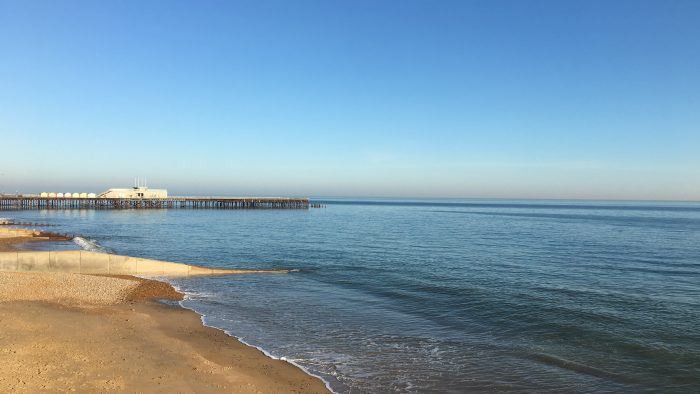
Hastings Pier

After 16 years, I am leaving The Chalfonts Community College (on Thursday!) to join The St Leonards Academy as Vice Principal.

Jennifer and I are relocating to Hastings to live and work by the sea. I took the photo above on the day I interviewed for the position. The role itself was certainly enticing but this view sealed the deal.

I am very excited about this opportunity. It is the ‘next step’ I have been working towards for some time now.

🚀🏖️🌞

Ask For Help

Kirk_Spock_BonesThis article by Kevin Gannon has been ruminating around my mind since I first read it. Not only do the four lessons that Kevin shares chime with my experiences as an Assistant Principal, but they can be applied by anyone to any situation: work, relationships or life in general.

  • Not every disagreement is a call to arms.
  • How and when I use my voice matters.
  • Don’t be afraid to ask for help.
  • Be good to people (including yourself).

If one of the above lessons speaks to me the most, it is the third. Whenever I mentor someone new it is the first piece of advice I offer. On the surface, asking for help, seems both obvious and simple. However, when you are placed in a position of authority it can feel far from simple. Asking for help requires the individual to remove their ego from the equation. Fear and/or arrogance are powerful character-traits but they will only hamper long-term success.

Appearing to have all the answers and can help you to demonstrate confidence, which is a much-needed trait in leadership. However, you will ultimately be judged on the success of your projects or areas of responsibility, and if you do not deliver as expected questions will be asked. It is here that cracks will appear and mistakes will be recognised. What often comes out in these situations is that you could have asked for help. Instead, you chose to see such an action as a sign of weakness and were willing to risk the success of the project to massage your ego.

In Gannon’s article, he contextualises this by considering the following common classroom conundrum. Should I admit to my students when I do not know something?

As a teacher, one of the most powerful things I can say to my students is “I don’t know,” because it shows them that I’m still learning, and it usually leads to us saying “let’s find out.” ~ Gannon, 2016.

I have long evangelised the need for educators to free themselves of the title of ‘teacher’ and to be open about their shortcomings. It is folly to present yourself as the fountain of all knowledge, and far more rewarding to experience your students’ learning journey as a collaborator. Learning is ‘interdependent’. It requires constant inquiry and is not nor should not be viewed as a one-way flow of information between educator and learner. When defining ‘connectivism’ in 2007, Stephen Downes stated:

At its heart, connectivism is the thesis that knowledge is distributed across a network of connections, and therefore that learning consists of the ability to construct and traverse those networks.

In very simple terms, learning happens through the connections we make with a number of different individuals across a number of different networks. Combining and connecting these various sources of information enrich our understanding of a topic or idea and free us of the belief that knowledge is derived from one single authorative source.

Within leadership this approach can be applied to the notion of asking for help. Effective administrators and leaders understand that ‘asking for help’ is not a sign of weakness but is rather a sign of strength. Great leaders surround themselves with trusted advisors. Similarly, students writing their Masters or Doctoral theses are encouraged to have a critical friend. We all need a network of people who we can turn to for help; people whose views we trust and value. Even better, people who are prepared to challenge us and ask difficult questions.

Weak leaders surround themselves with yes men who are afraid to argue with them. ~ Knapp, 2012.

Strong leaders do the opposite. They look to those whose views differ from their own in order to fully appreciate the implications that surround a decision that needs to be made, or better define the pros and cons of moving a project forward in a paricular way.

In essence, asking for help is an acknowedgement that before a decision is made or an action is taken, due consideration is required. It is not a weakness. It is a necessary step in ensuring that the decisions you make are well-informed. A decision made in this way is one that you can justify and explain with clarity. Fear and arrogance have no place in such an approach and like the educator who is prepared to say “I don’t know”, an effective leader is prepared to do the same.

Image via: TOR.COM.