Less, More and None (2020) – Review

Less

  • (cont.) spending time on ‘urgent but unimportant’ tasks
    • I did a much better job of this in 2020. I was able to be more strategic and to delegate tasks more willingly. Something I have always struggled with.
  • tinkering with apps and organisational tools (I need to pick a system and stick to it)
    • I broke this down into three areas (notes/schedule/projects) and settled on one app to manage each of them:
      • Drafts for writing: ideas, notes, lists, blog posts and reference material.
      • Fantastical to organise my day: lessons, meetings, calls and events.
      • OmniFocus for task and project management.
    • I also made some changes to my daily and weekly reviews that kept me better organised.
  • avoiding difficult / time-consuming tasks
    • I did well with this as well, in part due to the improvements I made to my organisation as noted above. In particular, I started using the ‘forecast tag’ in OmniFocus for these tasks and also scheduled time in my calendar for when I would work on them. This meant that they were always visible and would not be missed in my daily review. Scheduling time in my calendar meant that progress was made on them each day until they were done. Incremental progress FTW!

More

  • trying new foods and recipes
    • Jennifer and I are always exploring new recipes but we did even better this year building a wide range of new meals into each month. And like 2019, we struck a healthy balance between meat-based dishes and vegetarian ones.
  • rediscovering old music
    • I immersed myself in Jazz, exploring a wide range of styles (hard-bop, modal, avant-garde…) and musicians. I improved my knowledge of the genre’s development and discovered a number pieces that entered into regular rotation. My top three tunes for the year are:
    • Having spent a lot of time over the years listening to the more avant-garde and challenging work of Miles Davis and John Coltrane, I was surprised to see how much I leaned toward smooth and modal Jazz over the course of the year. Red Garland, Bill Evans and McCoy Tyner (all pianists) featured prominently. Maybe I am mellowing out!?
    • In addition to this, I also revisited a lot of music from my youth (80s/90s). According to Spotify, my most listened to artists this year were: Queen, Radiohead and Nick Cave.
    • I spent some time listening to classical music too; mostly Beethoven, Chopin, and Fauré, so the piano featured prominently there as well. Maybe I should learn to play the piano in 2021?
    • I made a number of new playlists in Spotify and updated some of my existing ones. They can all be found via my Spotify profile.
  • visiting new places
    • This did not happen for obvious reasons. Instead we made the most of our local area while doing all that we could to keep ourselves and other safe. The time spent here at home was not wasted though, I read more books than I have done in a long time.
  • mobility exercises and yoga
    • I failed miserably with this one unfortunately, and I haven’t done as well with my running over the last three months of the year either. Exercise has to be a habit and requires commitment. I will be re-committing to this in 2021 and ensuring that I can forge good habits to get back on track.
  • (cont.) writing
    • In terms of writing, I never truly found my mojo. That said, I did publish 24 full blog posts (20 more than 2019 ). Two blog posts per month is not what I was aiming for at the start of the year. As with exercise, writing has to become a habit. I will be committing to working towards this in 2021 as well.

None

  • (cont.) looking at my mobile phone when people are talking to me (still trying to make this stick!)
    • I finally made some headway with this in 2020. I took to leaving my phone on the coffee table or even in a different room and this helped. Still, I can do even better so this item will graduate to the ‘Less’ section for 2021.
  • saying yes to projects or ideas that will only have short-term or limited impact (aiming for a year of quality not quantity)
    • When faced with a pandemic, partial school closures and a constantly changing set of guidelines and rules, it has been hard not to have to work on projects that were about ‘short-term’ impact. Sometimes you simply have to adapt to the needs in front of you and I feel that alongside my colleagues, I did a good job in helping to keep the school going under very challenging circumstances.
In the Mood for Love

In the Mood for Love

Jennifer and I ushered in the Christmas break by treating ourselves to Chinese food and watching ‘In the Mood for Love’ by Wong Kar-Wai. It is a personal favourite; and one that we have enjoyed together for as long as we have been a couple.

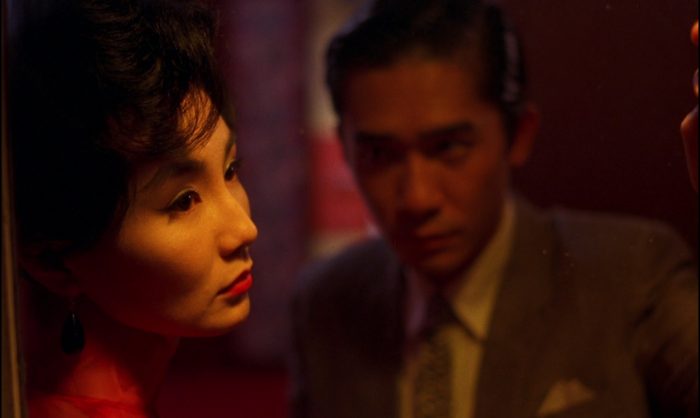
Built on a modest premise, Wong meticulously depicts the heartbreaking (unrequited) romance between Su Le-zhen (Maggie Cheung) and Chow Mo-wan (Tony Leung). Moving into next-door apartments with their spouses, they come to the unhappy realisation that their respective partners are cheating on them with each other. They consider the possibility of their own affair but agree they will not act on their feelings for each other, lest they be “no better than they are.”

The film’s impact is indebted to its modesty. The romance between the two leads evolves in vignettes: glancing looks, passing comments and brief encounters are all we are given for the first thirty minutes of the film. They only begin to spend more time in each other’s company once they admit the truth of their spouses’ infidelity. Yet, they never act on their true feelings for each other. As Roger Ebert noted, reviewing the film in 2001: “whole continents of emotions go unexplored”. Wong reinforces this narratively, skipping from event to event the connective tissue is discarded leaving space for the viewer to fill in the gaps. Like a good Hemingway novel, what is not said (or seen) is as important as what is.

As moving as the romance between the two leads is, this is not why I so frequently return to the film. ‘In the Mood for Love’ is a mood piece about Hong Kong in 1962. The soul of the film belongs to the city itself. The cinematography, mise-en-scène and music are expertly matched, capturing the city and its inhabitants in a very specific time and place. Drawing inspiration aesthetically from film noir (Wilder, Preminger), minimalism (Bresson) and narratively from Hitchcock (Vertigo/Rear Window), the Hong Kong of Wong’s childhood is rendered mysterious and alluring with a dream-like quality that is intensely beguiling.

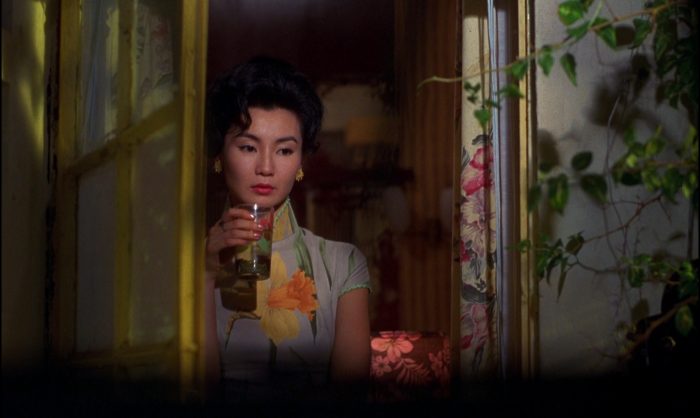
Shots linger, focussing on consequential and inconsequential details alike, and the pacing is deliberately slow. Even the many iconic tracking shots of Maggie Cheung, on her way to buy wonton noodles, add to the static, dreamlike quality of the film. As Wong put it himself: “We tried to recreate the film from our memories. And in our memories, everything moves much slower.” Filmed almost exclusively in medium shots and close ups, you are never quite sure where or when events are taking place; the scenes “surface and then submerge back into the murk of memory” (Steve Erickson, 2012). Low angles, and carefully positioned shots placed just outside windows or inside doorways create an intimacy with each location; placing the viewer in situ with the surroundings and characters.

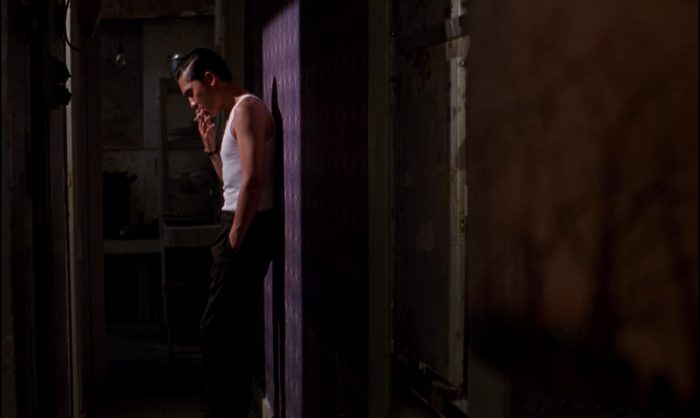
Chow Mo-wan smoking

Wong’s canvas is painted in saturated colours and musky hues. It is in one moment vibrant and the next shadowy and subdued. The props and costumes are similarly contrasting; Jadeite vases and cups standout against backdrops of deep reds and browns and the cheongsams worn by Maggie Cheung shift between warm and cold colours reflecting the changing mood of the film’s narrative. The music that complements the visual aesthetic is a mixture of perfectly timed pieces that capture a city caught between its past and present. Chinese opera and classics of the solitary island period sit comfortably alongside the gentle warmth of Nat King Cole. Yet it’s the haunting melody of Yumeji’s Theme that most accurately conveys the nostalgic, meditative atmosphere.

Every time I watch the film, I am struck by its contradictory nature. Exotic, yet universal; subtle, yet bold; it is a masterpiece of filmmaking that succeeds in being both mysterious and seductive. The streets, apartments, offices and noodle bars of 1960s Hong Kong are brought to life; and they are both gritty and romanticised. Through Wong’s dreamy, voyeuristic lens, the city becomes a part of your own memories.

He remembers those vanished years.
As though looking through a dusty window pane,
the past is something he could see, but not touch.
And everything he sees is blurred and indistinct.

~ Wong Kar Wai – In the Mood for Love

Playlists and Podcasts

I’m joining the heard (spiritually not physically) and sharing some playlists and podcasts to help you survive these strange and challenging times.

My playlists…

Currents is a regularly updated mix of music that has grabbed my attention, alongside a few tracks that seem to stick around for good.

Running, Clanging and Banging is my original running and workout mix. Over 200 tracks of uptempo rock, heavy metal, rap, dance and pop. Use it to work out at home or if you live near lots of open space and can get outside (responsibly), let this mix propel you.

For long morning runs, I started to lean more towards chilled out sounds. Running at First Light evolved out of this having tried running to the Marconi Union album: ‘Weightless’. The way the ambient sounds drifted into the background allowing me to focus more on my form and breathing had a massive impact on my running. The playlist is also great for yoga and meditation, as well as a good candidate for those of you who require calm, quiet focus, to get work done from home.

Electric Miles is my favourite playlist; exploring, arguably Miles Davis’ greatest and most experimental period. Starting with the epic 33 minute ‘Circle in the Round’; the playlist traverses five prolific years from 1968 to 1972, taking in such archetypal examples of Jazz Fusion as ‘In a Silent Way’ and ‘Bitches Brew’. Make some coffee, turn the lights down low, and lose yourself with Miles.

Sticking with Jazz, In a Silent Way is a contemplative mix of late night jazz to be enjoyed over dinner or with a glass of wine on a spring evening.

Finally, (A) Spoonful of Disney is perfect for the young at heart; sing along with and lighten the mood in these dark, sobering times.

You can find all of my playlists on Spotify.

Other people’s playlists…

One of the features of Spotify that I have enjoyed the most since I signed up is the rich network of music fans and artists who create and share playlists. Here are some playlists made by others that hit the spot.

I’ve been a fan of Merlin Mann for some time. Most people know him as the Inbox Zero guy. That seems like such a long time ago! He is, now, better known for his many podcasts, one of which I have listed below. He is a prolific music fan and the playlist: Merlin’s World of Music covers an extensive range of musical genres from the 60s through to the 00s. While there are a number of well known tracks, a significant portion of the playlist is made up of deep cuts and lesser known tunes.

I’m also a huge fan of electronic music; particularly that of Kraftwerk and Aphex Twin. This playlist by Pitchfork founder Ryan Schreiber highlights Richard David James’ piano playing. This is another good pick if you need to find focus when working from home. Also, if you love the 80s, Schreiber’s Poolside ’86 mix is ab-fab!

In hist most recent newsletter, Austin Kleon shared a fantastic series of “epic yearly survey playlists” by Fluxblog. We started with 1979 (the year I was born) on Friday. We are now part way through 1980. They are beautifully curated, seamlessly transitioning between moods and genres.

And some podcasts…

When I discovered the podcast Strong Songs, I was blown away. Kirk Hamilton’s analysis of the ‘strong songs’ he breaks down is deep and intricate. As a musician himself, he directs each track, exploring the nuances of melody, timing, key changes, musicianship and lyricism. To get started, I recommend the following episodes:

There is also a Spotify playlist of the songs from season one of the podcast.

The next two podcasts feature the Labour politician Ed Miliband and radio presenter Geoff Lloyd. The first, Reasons to be Cheerful is a ‘podcast about ideas’. Started in September 2017, the podcast explores a diverse range of ideas that could help us tackle the biggest problems facing the world today. Their guests include experts, campaigners, academics and politicians from across the globe. It is thought provoking and a fantastic way to stay informed.

In addition to this, Ed and Geoff recently launched a spin-off show: Cheerful Book Club. Each week they interview an author about their writing and their lives.

Finally, Back to Work with Dan Benjamin and the aforementioned Merlin Mann is the original productivity podcast. I have listened to every single episode since the show launched in January 2011. Their chemistry is fantastic, and the podcast has remained fresh, covering topics as broad as project management, smart-home devices and parenting. You can jump right in or if you want to dip into the back catalogue, I recommend episodes #1, #5, #7 and #9 which introduce some of the long running themes and bits that have become an integral part of the show.

I hope that you find something in here that helps you navigate the coming weeks as we continue to face up to the Covid-19 pandemic. Stay strong!

Fantastic run this morning. The air was fresh and crisp and I kept a consistent pace throughout. Not my quickest time but not far off my average:

10.03 km – 56:40 min – 5’38” pace

My current goal (after reading Footnotes) is to run without music.

Today, I ran the first five kilometres with music at half my normal volume; and the second five kilometres with it at less than a quarter of my normal volume. No impact on my pace and I was even more aware of the world around me…