#edread – Ideas & Values

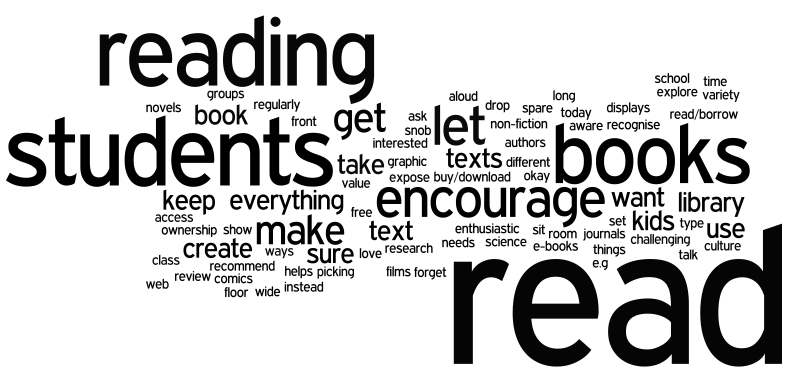
edread wordle

While resources, websites and apps are helpful tools I am firmly of the belief that it is the attitude and values that you take into the classroom with you that will have the greatest impact on whether you can engage your students in reading.

Here is a compendium of ideas and values shared by the wonderful members of my Twitter PLN that you can use to help your students engage in reading:

  • “Set kids free to read”
  • “Recognise everything that they read” – e.g. Science text book, comics, the web
  • “Make sure kids are aware of all the things they read”
  • “Read in front of your students”
  • “Read to your students”
  • “Read the books you love”
  • “Use graphic novels”
  • “Use e-books”
  • “Take them to the library”
  • “Take them to the library regularly”
  • “Talk about books in class”
  • “Get students to review and recommend books”
  • “Drop everything and read”
  • “Make time to read”
  • “Let them read what they want”
  • “Let them sit on the floor and read”
  • “Keep spare books in your room – let the students read/borrow them”
  • “Encourage them to read about what they are interested in”
  • “Show them different ways of picking books”
  • “Say its okay if they don’t want to read today – let them research instead – its a type of reading too!”
  • “Create a culture of reading”
  • “Make sure they can access non-fiction texts”
  • “Encourage students to read aloud”
  • “Encourage them to read in groups”
  • “Don’t forget films!”
  • “Create book displays”
  • “Get authors in school”
  • “Get students to keep reading journals”
  • “For some reading needs to be challenging”
  • “Expose them to a wide variety of texts”
  • “Ask students to buy/download books – ownership helps them value it”
  • “Encourage them to explore reading”
  • “Be enthusiastic”
  • “Don’t be a reading snob”
  • “Any text will do! As long as they are reading”
  • “Read well – make books come to life”

Thanks to everyone who has contributed to the #edread discussion.  I’m not going to post on this topic for a while but I will add resources to the main #edread page as they are shared on Twitter.

Remember you can see all of the tweets here and all of the resources that have been shared here.

Image created using Wordle.

What I Did With My Year 8s Yesterday…

love to read

…below is an e-mail I sent to the rest of the English department yesterday.  Having started #edread a little over a week ago and being a little tired after BBC School Report the day before I arrived in school on Friday morning caught between wanting to engage with my Year 8 class (my only KS3 lesson of the week) but also uninspired by the thought of either a grammar lesson or making them sit at desks and read within the confines of my classroom.

Instead of allowing either of these scenarios to be the start to my Year 8s’ Friday or mine for that matter I took them to the Learning Resource Centre (LRC) for their lesson – this is the grand title that is given to our school library.  I wanted to go and make use of it, I wanted to free them of the classroom and I wanted to focus them on reading for pleasure rather than reading the book they had been assigned.

Several of my colleagues replied to the e-mail offering positive feedback and saying that they were going to do something similar.  On reading through those comments this morning as I caught up with e-mail it dawned on me that here-in lied a blog post.  So here is the e-mail that I sent yesterday:

What I did with my Year 8s today…

…being up to date with Grammar lessons and my students being well on track with their class readers I did something different today.  When I taught a lot of KS3 I would regularly take my students to the LRC. So, that is what I did.

I talked to them about the fact that I had concerns about the amount of words my top set knew and understood and that I felt it was because 1. Some of them don’t read and 2. Some of them read the same thing all of the time – level of ability or genre.

I challenged my Y8 class to go out into the LRC and find something to read that they would not normally pick up and gave them 20 minutes to read.  I let them sit wherever and however they wanted – leaning against the book case, on the floor, in a comfy chair or at the table as I explained that I don’t sit and read at a desk but sit on my couch or read when I go to bed.  They were wonderful – absolutely silent as they read.  I think Emma (a cover supervisor & ex-student) who was in covering for Andrea (our wonderful LRC Manager) was in shock when she saw how perfectly they read and behaved!

I then did a short activity with them to get them thinking about what they had read – I asked them to answer openly and honestly the following questions:

  1. What is the name of the book you read?
  2. What genre is it – if you can’t put one word on it just describe it.
  3. Why would you not have normally picked up that sort of book?
  4. Did you / Did you not enjoy it?  Why?
  5. Even if you didn’t enjoy who would you recommend this book to – is there anyone in the class who you think would enjoy it.

I finished the lesson discussing “what” and “how” they read with them and challenged them to read one new text a week – be it a paragraph or two from a newspaper; to watch a documentary instead of EastEnders; to download a book to their iPod touch or iPhone – whatever works for them but to think about reading and to do it to enjoy it.

Just thought I would pass this on.  The LRC is a wonderful resource and space and we should (I feel) make more use of it.

Any thoughts, comments or ideas please pass them on.

Regards

James.

Image courtesy of Carlos Porto on Flickr.

Help Them Take The First Bite!

tree of knowledge


The apple cannot be stuck back on the Tree of Knowledge; once we begin to see, we are doomed and challenged to seek the strength to see more, not less.

~ Arthur Miller

Not only am I eager to help my students take the first bite of the apple, I’m literally clambering to help them rip the apple from the tree in the first place. Knowledge is power and attaining it is a challenge; even in the age of Google.

Teach your students to question, define, discuss, imagine, share, criticise, explore, speculate, evaluate and most importantly…to enjoy doing it. Teach them “to see more, not less”!

Image courtesy of j4mie on Flickr.

#edread – An Update!

crowd

On Thursday I began a ‘crowdsourced’ discussion about getting kids to read, titled #edread.

The purpose of this post is to:

  • Add clarification to the purpose of #edread
  • Clarify how you can get involved in the discussion
  • To show how many great ideas and resources have been shared already.

(Perhaps I should do a weekly update? – I will give this some thought!)

1. What is the purpose?
I have started the discussion to develop a fuller understanding of how to engage students in reading and to also collate a bank of resources that can be used for this purpose.  While starting the discussion it became clear that there were three different types of student who I wish to focus on:

  • The student who does not read at all and does not see any value in it.
  • The student who wants to read but is afraid as they feel that they simply “can’t read”.
  • The student who knows they can read but is happy to coast along reading the same (level) book rather than challenging themselves with higher (level) material.

2. How do you get involved?
Simply share any ideas, thoughts, links or resources on Twitter using the #edread hash tag.

I have set up an archive of #edread tweets here.  And there is a dedicated page to #edread here on my blog.

3. Ideas and resources shared on Twitter so far:
Thank you to everyone who has gotten involved already. Here is what has been shared so far. (I have removed the #edread hash tag and also done some cleaning up – replaced abbreviations with full words, changed grammar etc.)

  • kvnmcl Make time to read to the class every day – whether it be from a book, comic, newspaper, child’s story – read to them and read well.
  • joysimpson “Book displays deeply affect the mindset of those who see them” – Aiden Chambers. Book corners/displays in classrooms matter.
  • joysimpson Lists available such as – if you like..(Tracy Beaker.).then you might like these… Librarians to help and use of Google docs to create.
  • missbrownsword children are never too old to be read to, brings books to life for them.
  • missbrownsword get authors into school.
  • daveterron When having silent reading, read a book as well. Set an example and they’ll follow. (Sound advice, I have done this since I trained to teach.)
  • missbrownsword use reading journals to encourage kids to engage with what they’re reading.
  • Joga5 In Primary have storytelling at break and lunchtimes – could be MDSAs, staff, volunteers (1 school I know has crowdsource events!)
  • DKMead @missbrownsword have you seen peelweb.org. It has a great structure for reading logs encouraging thoughtful interaction with texts.
  • Joga5 Remember that reading has to be uncomfortable and challenging at times (challenge, subject matter, genre etc).
  • Joga5 (Primary) Swap teachers around to read to classes on regular occasions.
  • Joga5 Kids aren’t stupid. Don’t restrict an emphasis on reading to World Book Day & Book Week – be consistent with fun splurges of events.
  • missbrownsword when I was a bookseller I often went into schools to do reading workshops, teachers – make friends with booksellers!
  • missbrownsword RT @MichaelRosenYes My 20 point ‘how to make a book-loving school’ at www.readingrevolution.co.uk.
  • damoward RT @jamesmichie: use a wide variety of texts in lessons 2 let them experience different types of writing & language.
  • jamesmichie use wallwisher as a book review page to encourage reading – get students to write a short summary, opinion and include a picture of the book.
  • jamesmichietake your new Year 7s to the library often, teach them how to select a book to read – encourage them to explore.
    • BiancaH80@jamesmichie That’s a great idea. Sounds so simple but it’s so important. I haven’t taken mine once. I will next week.
      • jamesmichie @BiancaH80 thanks, when I had a Year 7 class I took them at least once per half term – I sat with them & discussed their choices.
  • jamesmichie when studying a class novel get students to buy/download it – ownership of the text helps them to value it.
  • BiancaH80 We do literature circles at our school – started last year. I’d like to do it once a term. Mini-bookclubs.
  • BiancaH80 These bookmarks are great: http://bit.ly/d1Z7IH Get them to write you a letter about their book.
  • IDrumly Make a museum of artifacts as you read. Encourage food, clothes, diary. Design FaceBook pages for characters. Choose actors for a new movie adaptation.
  • jamesmichie great presentation about reading strategies by Bill Boyd: http://bit.ly/3hZ7rJ and lots more great material on his blog: http://bit.ly/fUgdG.
  • AntHeald My school is using AR – http://bit.ly/9URFR8 Definitely working for some.
I hope that if you are reading this you are finding it useful?  If you have not contributed yet please join the discussion and share your ideas via Twitter using the hash tag #edread.Image courtesy of Hannes Treichl on Flickr.

Assessment For Learning With Twitter

There is a lot of discussion within the #edtech community about the value of using Twitter within the classroom, which is, in turn, followed by a second conversation about whether educators should be using Twitter in school at all.

I personally believe that Twitter has the potential to be invaluable within education as long as the right safeguarding precautions are taken.

The most obvious use for Twitter I feel is to utilise it as a tool for giving feedback as part of assessment for learning.  Therefore, I decided to start there and trial this with one of my Year 10 classes.  Why Year 10?  Mainly due to the fact that I believe they are mature enough to handle the use of Twitter sensibly and that if successful it could become part of our working process; having time to develop its use through to the end of Year 10 and beyond.

My students set up their accounts with me in the classroom.  I gave them a clear set of instructions about how to set their account up – most importantly that their account name be created in such a way that they can not be personally identified by it and that their account is locked so that they can control who is following them.  To make the “following” aspect even more straightforward I followed (with a specific Twitter account I set up for use in school) all of them and created a group “list” that they could then follow.  It meant that they were not searching through lots of other people to find each other and possibly coming into contact with people and tweets that they shouldn’t.

I wanted to be sure that they looked on this as an educational tool – although that was not too hard as some of them were quick to tell me that: “Twitter is for old people like you sir and Facebook is for us, teenagers!” – thanks a lot I thought to myself.

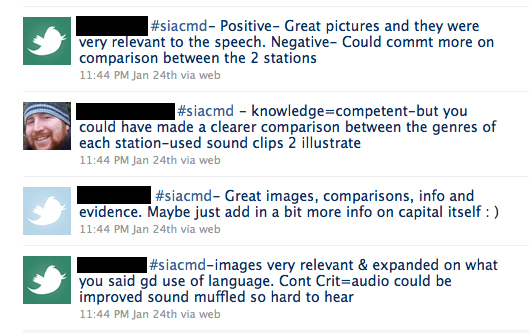
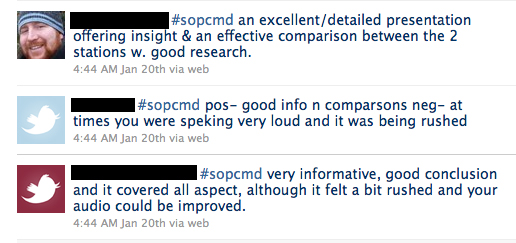
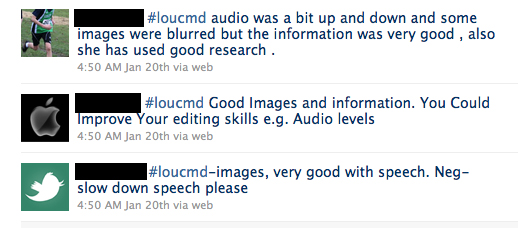
The group of students I decided to trial this with were my Creative Media Diploma students.  They are a small pilot group so provided a situation that was manageable to try out a new form of Assessment For Learning.  Here are some examples of tweets by the students:
twit feedback 1

I feel that the 140 character limit was actually one of the most effective aspects of the process – the students found it challenging at first but once they got over the fact that they were being allowed to communicate as they would in a text message or e-mail with friends they quickly adapted and began sending very short but constructive comments to each other.  The unit had culminated in the students creating a multi-media presentation (animated still images and audio) comparing BBC Radio 2 with either Capital FM or XFM.  The students were required to evaluate both the analytical content of the presentations and the visual/auditory features.
twit feedback 3

To facilitate the process each student was assigned a hash tag which was made up from the first three letters of their name and then the initials of the course “cmd”.  This allowed for easy searching and provided some uniformity and structure to the task. I asked them to make one positive comment and one comment that offered some constructive criticism.  This was handled fairly well and only one student on one occasion wrote something about another students work that the rest of the class and I felt was not appropriate.  Due to the public nature of the process the students were quicker than I in picking up on it, making the student who sent it send a tweet apologising and for them to delete the offending tweet.  You see it is about teaching the responsibility.  If we treat what we do online seriously they will take it seriously.
twit feedback 2

Each hash tag ended with cmd as an identifier of the task being evaluated.

After the evaluations were complete the students were asked in the following lesson to use Twitter Search to locate all of their tweets.  They printed out a copy of all the tweets that contained their given hash tag for their portfolio and read through them reflecting on the positive and negative points that they had been given.  They then set themselves two targets. One target explaining how they could improve the content of their presentation and one target as to how they could improve the visual/auditory features.  Here is an example of a students targets which they submitted to our Virtual Learning Environment (moodle), printed out and stapled to their tweets inside their portfolio.

example of target setting

This was an enjoyable and (I feel) highly effective process.  It certainly was for me as a teacher, being able to offer feedback and advice instantly but in an alternative way to the usual verbal approach.  The 140 character limit helped I believe as I had to get to the point rather than waffling on! There was a record of it all, just as if I had filled in some laborious assessment sheet. And they were able to respond to the feedback and they got to not just know what I thought but what their peers thought as well.

Furthermore, it was helpful to me to see what the other students were saying – giving me an insight into the way they saw each others work at the same time I was assessing and evaluating it.  This made me stop sometimes and re-evaluate what I was saying in terms of feedback.  As the process developed, being able to read each others tweets, we all got better at it – providing better and better feedback for the student being evaluated.

While Twitter remains available at school I will definitely use it again for this process and hopefully for others.  I have considered using Twitter to help develop my Y10 English class’ writing skills – a story or poem developed tweet by tweet!  I also saw, just today, as I was working on this post that @tombarrett used Twitter in his classroom today using his PLN to tweet what the weather was like in different parts of the country.  I’ll say no more as I know that he plans to blog about it himself! This to me was a fantastic use of Twitter in school and exemplifies the value of it being left open and free for use, not shut down (behind a firewall) like so many other great social learning tools seem to be.

If you would like to know more about this project or other ways I plan to use Twitter in my classroom please feel free to tweet me @jamesmichie.