Education Eye – Mapping Innovations

education eye

I received an email today from Sarah Grier at FutureLab to inform me that my blog has been selected to feature on Education Eye.

In her words: “Education Eye is a free resource for the education community, pulling together a wide range of relevant and useful innovations selected from the best of the web and updated daily.”

In my words: Education Eye is a search engine by which you can find useful articles, blog posts and resources. Many of the articles (innovations) have been suggested by users of the site and the information is presented via a visually engaging user interface that brings joy to your searching.

The site also offer a variety of features which I have yet to try out but seem at first glance very useful, including the ability to register for email updates, a personalised home page and the ability to favourite articles and resources that you find useful.

So go on, click on the link and give it a try. If you’re not sure where to begin, how about a cheeky search for “James Michie” – you never know what you might find!

Welcome to ‘the zone of optimal challenge’

Futuelab Logo

Last week Merlin John (@merlinjohn) published an article (through FutureLab) titled: “Welcome to ‘the zone of optimal challenge’.” The article is about the Online Games Design course that I was involved with and have tweeted about often using the hash tag #cmdgames. Merlin asked me to provide a quote for the article and I was more than happy to oblige.

He followed up the FutureLAb article with an additional piece on his own blog: Merlin John Online titled: “Chalfonts scores high with Games Design Workshop”.

You can find out more about both the Online Games Design course and the Creative Media Diploma on the Chalfonts Community College ‘Creative Media Diploma Blog’‘. Working to a “real”, “creative” brief, the students collaborated in groups to produce a game related to the 2010 paralympics. The finished work is fabulous and links to play the games can be found here.

The online course was a tremendous success, breaking new ground for online learning and providing further proof of the value that video based conferencing tools (Adobe Connect) can have within education.

The brainchild of Greg Hodgson (@greghodgson) and Roxana Hadad (@rhadad), the online course lasted for 10 weeks and was supported by classroom teaching and a dedicated Moodle course – used to help the students remain organised as they worked on developing their skills as both game designers and game makers.

The students thoroughly enjoyed taking part and the level of progress they made was fantastic. Alongside Greg and Roxana there were a wide variety of people involved in making the course happen including myself, Hannah Stower (@hstower) – Leader for the Creative Media Diploma, Ian Usher (@iusher) – Buckinghamshire E-Learning Co-ordinator, and a sleugh of games designers (who spoke on the course) including Colin Maxwell (@camaxwell) and Josh Diaz (@dizzyjosh).

Thanks to Merlin for writing the articles. I really enjoyed being involved in delivering the course and look forward to helping to improve and deliver it next year.

If you would like to know more about the online course or about our use of Adobe Connect please contact me by email or send me a tweet @jamesmichie.

Vale a pena ficar de olho nesse blog!

“Vale a pena ficar de olho nesse blog!” or to those of us who speak English: “It’s worth taking a look at this blog!” Thank you to Jan Webb for including me in her list of 10 blogs that are worth taking a look at.

If you are included below and wish to take part in the project; simply copy the image from above and the title of this post. Make a new post on your own blog; including them, and your list of the 10 blogs you think others should take a look at.

Okay. On with my list:

Doug Belshaw is an inspiration to many of us who marvel at his insane levels of productivity! His blog is always insightful, always useful and being someone who loves clean aesthetic design, his blog is beautiful to look at/read. Doug and his blog were one of the final catalysts that led to me writing my own blog and I have tried to borrow some of those design aesthetics in putting together my blog.

Richard Byrne seems to be a man on a mission to catalogue and provide his PLN with an entire library of educational tools, apps, software and websites; keeping them innovating in the classroom until the end of time. He is the most prolific blogger in my Google Reader. Simply awesome!

Tom Barrett quickly became one of my heroes when I joined Twitter. He will retweet you, recommend you and help you get your PLN off the ground. His posts centre around educational technology posting about great apps and tools. However, as a leader in the edtech community, the true worth in Tom’s blog comes from his ideas and thoughts about edtech itself and the pedagogy involved. To see what I mean check out this post called “Whispering Change”.

James Clay‘s blog is another great edtech read, particularly his series of posts titled “100 ways to use a VLE”. As an avid user of my schools VLE (Moodle) I find these posts exceptionally useful whether they introduce a new idea, reinforce something I have already been doing or remind of something I had forgotten about. This brings me nicely to the next two blogs which are also Moodle related.

Ian Usher is Buckinghamshire’s eLearning co-ordinator and helped set up our VLE. He is a “Moodle” afficinadao and his blog tends to centre around this – exploring the use of Moodle across a series of schools which he has worked. He also blogs on other edtech related ideas, pedagogy and tools. And as an added bonus, if you subscribe to his blog feed you will also get regular updates from his delicious links.

Kristian Still is someone I have gotten to know recently; he, being directly involved in this years Moodle Moot. (You can read his guest posts featured on Moodle Monthly about the #mootuk10 here: Day 1 and here: Day 2) Kristain posts regularly on a wide variety of education related areas including edtech, leadership and 21st Century Learning – a topic that is if great personal interest to me as it has been at the forefront of my thinking and classroom practice for the last few years. His writing style serves him well, creating clear and informative posts with a personal conversational tone.

David Mitchell‘s blog is really interesting as he is simply not afraid to try out new and innovative ideas inside and outside of the classroom. Search back through the posts to see how he is getting on with using mobile technology in the classroom, Cover It Live, Voicethread for peer assessment, Twitter and class blogging amongst other things. Reading about his methodology and his sheer willingness to give it a go serves as a constant reminder that you must not stay stagnant as an educator. You must keep looking for ways to improve the learning for your students.

Dai Barnes writes on edtech, pedagogy and innovation. His posts are always stimulating and, like several of the other educators I have included in this list, he is leading the way in thinking about 21st Century Education. His blog is well structured to allow you to find information on key areas of interest including Moodle, eLearning and mobile technology.

Chickensaltash is a great educator who waxes lyrical on day to day learning, edtech and the 21st Century Classroom. His posts regularly end up in my Instapaper account to read later as the guy can write and write and write! Therefore, I often need to save them till I have more time to read them and digest the ideas within.

I have included the Instapaper Blog in this list as Instapaper is my favourite web app of all time. It is integral to both my web work flow and personal productivity. It was the second web app that I used Fluid to turn into a desktop based app and the excellent, regularly updated iPhone app has become my most used app on my iPod touch. You can read my post about creating desktop apps with Fluid (including Instapaper) here. Their recent posts have included many updates on the development of their iPad app which looks stunning…check out the pics in this post. If you love design simplicity like I do you will love the way this app looks!

And that’s it; 10 blogs I think you should take a look at. Please leave comments if you wish and as always you can contact me on Twitter @jamesmichie.


#mootuk10 (Holes In Walls & Cyberspace)

I just found out that I have been quoted in an article on Moodle Monthly written by Kristian Still (@Kristianstill) and Craig Sumner (@hamblecollege). The article offers a recap of the first day of this years Moodle Moot UK. You can read the article here.

I am quoted, responding to the back channel discussion (via Twitter) that was flowing, in response to Professor Sugata Mitra’s keynote on “Hole In The Wall”. A stunning and humbling project which began in 1999 when he was working in Delhi. Working next to a slum he knocked through a wall and stuck a computer in with an Internet connection. After just a month many kids had taught themselves to use the computer improving their literacy and numeracy skills. This turned into a huge project that has seen massive success.

His talk, while I am yet to see it, was clearly very inspirational as it prompted masses of praise on Twitter and sparked a very interesting discussion about the nature of learning, literacy and the benefits/drawbacks of different learning environments.

Learning environments is a topic within eduction that I have been researching and discussing quite a lot recently after reading “Campfires in Cyberspace” by David D. Thornburg, Ph.D. I was therefore naturally intrigued by the discussion arising on Twitter and got involved.

I am currently working on a visualisation of the ideas presented in “Campfires in Cyberspace” and will be blogging about this in the near future. To help myself in this process I used MindNode to create a mind map (click to view/download the mind map) of the concepts presented in the paper, collecting my thoughts and ideas as I read.

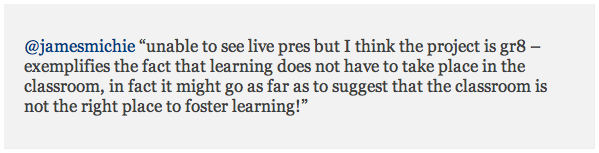
Both Prof. Mitra and Prof. Thornburg, Ph. D. through their research raise some very interesting ideas about the way learning takes place and the environments in which that learning happens. My own thoughts at the moment are centered (as the quote in the article suggests) around the idea that the traditional notion of the classroom as “learning environment” is outdated and that “learning” is not constrained to any one environment but is facilitated by multiple / interchangeable environments – many of which are free of walls; be it outside (like the “Hole In The Wall” project) or virtually (in “Cyberspace”).

Here is the quote as featured in the Moodle Monthly article:

I will stop there as I am using up content that will be included in a future post.

Moodle Moot UK (#mootuk10) seemed enthralling and I really wish I could have been there today. I was happy to follow the conversation online however and as usual the wonderful people on Twitter provided me with much food for thought today. You can catch up with and follow the tweets from Moodle Moot UK via Twitter Search here or view the archive on Twapper Keeper here. Why not go one step further and join in with the discussion – the hash tag for the event is #mootuk10.

Find out more about Professor Mitra and the “Hole In The Wall” project at the following links:

Find out more about Moodle and Moodle Moot UK here:

Find out more about Professor Thornburg, Ph. D. here:

Thanks to Kristian and Craig for including me in their article.

If you would like to know more about anything mentioned in this post please e-mail me or contact me on twitter @jamesmichie. Comments are always welcome.