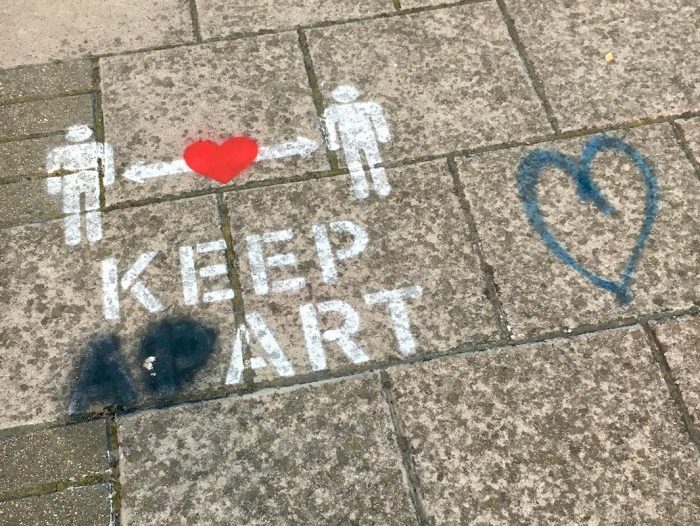
Spotted on my morning run… #remix #streetart
Spotted on my morning run… #remix #streetart
“The fact is that given the challenges we face, education doesn’t need to be reformed — it needs to be transformed. The key to this transformation is not to standardise education, but to personalise it, to build achievement on discovering the individual talents of each child, to put students in an environment where they want to learn and where they can naturally discover their true passions.”
― Robinson, Ken, The Element: How Finding Your Passion Changes Everything, 2009
I was very sad to learn of Sir Ken Robinson‘s passing.
His 2006 TED Talk and subsequent work had a profound effect on my educational outlook and practice; and featured significantly in my M.Ed.
Schools should be places where young people have room to breathe and grow; able to explore ideas and make mistakes; where creativity is not only encouraged but actively nurtured. Those of us at the chalkface can honour his memory by working every day to “inspire and engage the imagination and creativity of the students” we teach.
If you haven’t read ‘Out of Our Minds‘ or ‘The Element‘, now would be a good time to do so; not least given the disruption that the pandemic has wrought on schools over the past six months.
Perhaps there is another way – free from ‘one size fits all’ and ‘standardised tests’, where children are not “educated out of” creativity.
Over the last four years, I have worked hard to make my blog as light, secure and privacy conscious as possible. ‘Https’ is forced across my entire domain; it is hosted on a European server; uses no analytics (Google and/or Jetpack); and the least amount of plugins1 possible.
When visiting my blog you should find that it is fast and, most importantly, not tracking you.
This is true most of the time but there are some exceptions where content has been embedded from external sites. The list of offenders is small (YouTube, Twitter, Instagram) but I am not happy that their presence allows them to intrude on my readers’ privacy none the less. It also meant, arguably, that I was not fully GDPR compliant.
Doing some research into this issue, I came across a post by Dries Buytaert discussing the ‘cookies’ that are installed from embedded YouTube videos. He discovered that YouTube provides a privacy-enhanced way to embed videos on your blog without leaving a cookie. Instead of using youtube.com you can use youtube-nocookie.com instead.
I finally got round to putting this into practice and spent a couple of hours this morning editing all of the YouTube videos embedded on my blog to use the following code:
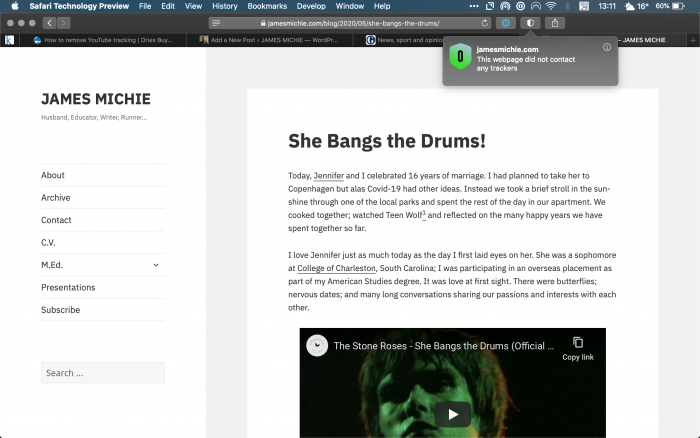
<iframe src="https://www.youtube-nocookie.com/embed/video-id" width="560" height="315" frameborder="0" allowfullscreen="allowfullscreen"></iframe>Testing a post in Safari, it is clear that it has worked correctly. The YouTube video is embedded and plays as expected but no trackers were contacted.
While doing this, I also found a number of broken links and some embedded audio files that were no longer working. I fixed those along the way, making for a very productive morning. Winning! 😃
The next step is to see if I can achieve the same with the handful of tweets and Instagram posts that I have embedded on my blog.
I have been relatively silent amidst the turmoil that has arisen out of the collective deep-breath forced upon us by the pandemic. Where I initially saw hope for change, it was quickly cancelled by an onslaught of rhetoric on both sides of the aisle that left no room for mercy, compassion and tolerance.
Race, gender, religion, wealth: All topics fraught with difficulty at the best of times and I have struggled to fully form the words I would use to express how I feel about any of these issues in the current climate. However, Nick Cave has come to my rescue responding to questions about ‘mercy’ and ‘cancel culture‘ on his blog…
Mercy is a value that should be at the heart of any functioning and tolerant society. Mercy ultimately acknowledges that we are all imperfect and in doing so allows us the oxygen to breathe — to feel protected within a society, through our mutual fallibility. Without mercy a society loses its soul, and devours itself…
As far as I can see, cancel culture is mercy’s antithesis. Political correctness has grown to become the unhappiest religion in the world. Its once honourable attempt to reimagine our society in a more equitable way now embodies all the worst aspects that religion has to offer (and none of the beauty) — moral certainty and self-righteousness shorn even of the capacity for redemption. It has become quite literally, bad religion run amuck.
And there it is…
We cannot and should not deny our history, nor should we try to remove it as if it never happened. If society is to be equal, we must work openly to build a wider more honest narrative about our histories – good or bad. We must ensure that education provides the opportunity for people of all cultures and backgrounds to learn and debate ideas free from persecution.
But if we seek to simply cancel out the pieces of our past that we are angry about or not proud of, we will replace one biased view of the world with another. You can only redeem yourself when you are able to acknowledge your mistakes. As humans, we are more likely to do that, in a society that is open and merciful.
—
N.B. None of this is to say that I don’t appreciate the deeply held anger felt by so many people due to the way their gender, race, religion, sexual preference, et al, has been and continues to be treated. The struggle is real. However, we must strive to be better than those who came before us and not allow our baser instincts to drive our actions and decisions as we seek to make society a more fair and equal place for generations to come.
Perfect start to the weekend…

Breakfast ☕️ 🥐 on the beach 🏖 with Jennifer Michie, followed by an invigorating swim. 🌊 🏊♂️
Representing @ReclaimHosting #InTheWild