Busting a hole in the wall (the purpose of education)

purposed-badgeWhen Sugata Mitra put a computer inside a hole in the wall of the NIIT building in New Delhi, he took the first step in proving beyond a shadow of a doubt, that education was a universal connector craved by people the world over; and that the traditional notion of classroom education was by no means the only way to do it. Now, more than ten years on from the beginning of the HITW experiment, the lessons remain unheeded by many of the people involved in mainstream education. In fact, concepts such as ‘self-directed learning’ and ‘the student voice’ are still scoffed at as Dawn Hallybone was reminded this past week, attending a debate on the National Curriculum review.

Are there still that many people connected to education that truly believe, we, the adults know what’s best for the next generation and the one after that? Nick Dennis spoke of the need for us to focus on principles in this debate and at first I disagreed, as principles like ‘purposes’ are rarely universally shared. However, I now see where he was going, and while I appreciated Doug’s question about whose “better” was Nick referring to, I think Nick’s conviction was what was most important. He asked the big questions about what we want education to be and what we are doing for each other as a community, not as definable roles but as human beings.

It is make or break time for humanity and we have a responsibility to draw a line in the sand, admit our mistakes and create a system of education that can begin to undo the harm that we have done to the world. For all the talk over the last twenty years of the ‘global village’, it has not stopped us continuing to destroy our planet, to wage wars and to continue to ignore the inequalities in society. What is the purpose of education? Surely, it is to create unity by helping future generation to recognise the values that humanity share.

Fred Garnett grapsed this when he argued that new (social) media can foster “collaborative, discursive learning, the kind of learning that creates a healthy, open and participative society.” Is this the extension of Mitra’s experiment? Is social media the natural evolution bringing learners to the stream rather than the well? Some of us embrace change, recognising the merits of experimentation and creativity; others fear it, seeing new as dangerous. I’m not suggesting that we should plunge head first into wildly unstructured models of learning but if it were not for people who dared to be creative, who dared to experiment, we would not be able to stare into the vast ocean that is our solar system, or be able to listen to Mozart on a device, so small, it can fit into the palms of our hands.

When Mitra began his experiment he was giving education back to the people and his observations of the children showed happy, creative, collaborative learnings, the sort of learning Tom Barrett hopes his son will continue to experience. I’d intended to say that education is about more than opening doors; it’s about what you do once the door is open. Now I’m asking who needs doors? Why not work together and bust a hole in the wall instead?

#writewell – A Gifted and Talented Writing Project

On Tuesday afternoon when the majority of students were making their way home, 15 dedicated Year 11s remained behind to take part in a project that I am leading with five colleagues from the English department. The short term aim is to improve on these, already, talented writers skills, hopefully helping them to achieve A*s in English. The long term aim is to help them become better and more critical writers, oozing with confidence whenever they put pen to paper or finger to keys.

100 Words

The project is running for ten weeks and includes a variety of facets. One of which is teachers, parents, writers and others offering 100 words on why being able to #writewell is important.

Here’s a flavour of what has been shared so far:

“With a talent such as writing well, it allows the reader to feel your passion, feed off your enthusiasm or understand your reasoning which all help in your path to success.” (Corrie Fenner, Teacher of PE)

“From my perspective, if a candidate can’t write their CV and covering letter well, how can I trust that they will accurately “proof read” a press release, direct mail piece or html email?” (Liz Wilkins, Senior Marketing Manager for Education, Adobe Systems Europe, Ltd)

“My favourite meal consists of a glass of milk, crisps and egg sandwiches.

If it wasn’t for the comma you might think I had invented something called “milk crisps”, which could be the dried up flakey bits just around the rim of a plastic bottle of milk – but that would be disgusting!” (Julian Smith, Leader for Drama and Performing Arts)

140 Characters

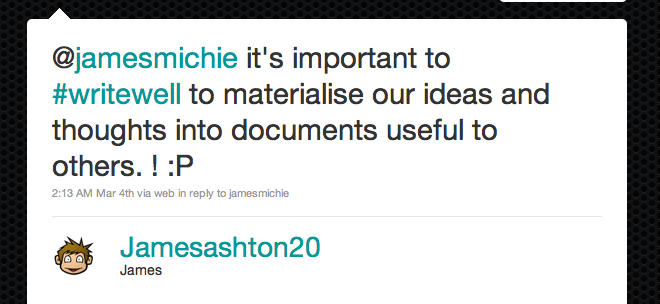
I also asked my awesome PLN to get involved via Twitter and offer 140 characters on why being able to #writewell is important. I loved this one:

#writewell tweet

Student Blogging

The students involvement centres around a series of taught sessions, seminars and individual tutorials; input from professional writers, including: an author, editor and professional copy-writer; and most importantly it includes the student’s writing which will be produced on their own blogs – putting their words out in to the public sphere to be praised and scrutinised.

It is our hope that the public forum combined with a range of creative exercises and experiences will help these talented writers to fully realise their potential and also eradicate some lingering inaccuracies that find their way into the students work. It is our hope that we will help them to see that being able to #writewell is vital to their futures.

For ease, a lot of the material related to the project is being collated and managed via our schools VLE so I am unable to share all of it with you. However, the students’ blogs (the heart of the project) can be found in the sidebar on the right of the English department blog. If you are an educator, parent or fellow student, please take a moment or two to read some of the students’ posts and perhaps even leave a comment. Please offer praise where it is due but also offer some advice and guidance on how the student could further improve the quality of their writing. This I believe is integral to the success of the project.

Each week the students will be given a specific writing activity. The opening task asked them to write about an object that has significant meaning to them. Here are the first three posts that were submitted, I think they have gotten off to a great start:

As the project evolves the writing activities will be supplemented by reflection and evaluation activities. We also expect the students to comment on each others writing. And we hope for there to be the opportunity for some collaborative writing to occur as well.

If you are on Twitter you can follow the project via the hash tag: #writewell. And if you have a few minutes perhaps you could tweet about ‘why it is important to #writewell’?

We hope that you enjoy reading the students’ posts as well as watching the project grow as much as we expect to.

—

This was an edited version of the post I submitted to English @ CCC.

In the Vital Hotseat

VitalMy colleague, Greg Hodgson, and I are currently hosting a Vital Hotseat adding our knowledge, experitse and opinions to a two week discussion titled: ‘Enhancing Creativity Through Digital Media‘.

Topics under discussion so far include: ‘Getting in the creative habit‘ and ‘Collaborative work with external partners‘.

You need a Vital account to join the discussion but it is free and takes little time to set up. Along with hosting forum based events such as this, Vital also support TeachMeets and provide a wide range of resources for educators on their website.

So please, sign up and join the discussion.

More on the challenges facing education…

Having shared some of my thoughts on the challenges facing education on Friday, I have spent the last couple of days reading and commenting on a number of the fantastic purpos/ed posts submitted by educators across the web as part of Doug Belshaw and Andy Stews’ #500words campaign.

One post that really grabbed my attention was Fred Garnett’s post: ‘The Purpose of Education’. Fred suggest that our position as subjects rather than citizens has significantly impacted on our acceptance of the ‘National Curriculum’ for this long. He also, draws upon many different voices including Pat Kane and Sugata Mitra to help add clarity to his belief that education needs to be far more democratic built upon collaboration and learners’ interests.  It was Fred’s reflection on his own teaching experiences though that really made me think and forced me to comment on the post:

Having taught Politics to rich kids in the USA and then Computing to poor kids in Lewisham I concluded that the only difference between them was that the poor kids expected to fail. I decided that I should focus on motivating them to believe in themselves rather than burying them with curriculum facts.

This got me thinking (particularly in terms of school based education) that the challenges facing education are effected by the wealth of the area/community in which a particular school exists.

I asked Fred if it was okay for me to republish my reply here and he enthusiastically said yes. Below is a slightly edited version of my response to Fred’s post, you can read the post and see my response in its original context here.

—

Education: A dichotomy of challenges?

Great post Fred, I think your contrasting teaching experiences in the US and here in the UK highlight two distinct challenges that face educators today.

Challenge one is faced by educators teaching in communities where ‘expected failure’ has become the norm and thus turned a community (particularly the young) against education. They don’t see being smart and learning as ‘cool’. To them learning reeks of potential failure and so they ridicule it, diminishing its value (in their eyes).

Challenge two is faced by educators in far more affluent areas where young people have greater opportunities and value their time in school, not necessarily for the learning experiences but for the grades that they wish to achieve in order to take the next steps towards their ‘expected future success’.

Educators who find themselves facing one of these challenges have an equally difficult path to tread.

Educators facing challenge one have the inarguably difficult task on motivating young people who see little or no value in education – reinforced not only by their peers but by parents, by their neighbourhood, by the lack of opportunities within their community. They have to find ways to show them that they can be successful and to raise their expectations.

Educators facing challenge two on the other hand have to fight apathy from some while helping many others to understand that failure is a valid and valuable learning experience. This is difficult because it is not just the students who see failure as a bad thing, it is the parents, other teachers and the government who have fostered a society that judges success based on grades and financial worth.

To put this into an equation: Better grades + Better University = Financial Success.

With this mindset firmly entrenched it is exceptionally difficult to convince some youngsters that they can learn as much from failing as they can from succeeding. The conceptual logic for many is beyond them.

And these two challenges are not separate sides of a coin. In fact they are indelibly intertwined. The parents of challenge two children place them in direct opposition to the children of challenge one, and vice versa. Children who believe that failure is unacceptable tend to look down on those who fail and this show little empathy towards poorer people for example (I am massively generalising here) and in turn children who see success as unachievable sneer and mock those people who in society seem to be successful (all be it financially).

A society divided

So, where am I going with this? I think that education has to be about opening doors for people of all walks of life. It has to transcend culture, religion, wealth, race, age and so on. But to do that society has to change. The biggest challenge facing education and the one that will have the hugest impact on helping to decide what the purpose of education is, is whether or not the richest and the poorest in society can stop seeing each other as different and find common ground. Perhaps the common ground should be education, perhaps schools are the place for this common ground to be forged, perhaps schools need to be opened up and put right at the centre of each and every community? Perhaps schools can help mend a divided society?

Centres of Learning

I have been following with interest the furore over the potential closure of many public libraries. Some have suggested that a potential solution would be for the local school library to be used by the public as well. Some thought this sounded great, others were horrified by the idea convinced that it would put children at risk. Have we gone mad? Are young people not around adults all of the time when they leave school at 3:30? Do we really believe that every single adult who walks into a school is a child molester or pedophile? I think that the idea of making the school library the public library is a stunning idea. I think we should go further and rebrand our schools as ‘Centres of Learning’ where anyone of any age can come and take classes, use the library, gain access to IT equipment. Why should a child of 14 not sit next to an adult of 44 and learn French. I am sure when the 14 year old turns around to the 44 year old and asks why they are here, the answer will be as valuable learning experience as any – particularly as that answer would likely be: “because I wished that I had learned it when I was in school.”

Think of the potential value of young people sharing their resources with their elders; their parents and their grandparents. They can teach each other. I think as a society we have forgotten what a community is. I think we have forgotten to value all types of learning putting education solely on the hands of the government and schools. Education belongs to the community – to the people – it is for everyone!

—

If you want to read more on the purpose of education and the challenges facing it check out all of the #500words posts here. Along side Fred Garnetts post, other notable posts (IMO) include Tom Barrett’s very personal post: ‘What is the purpose of education?’ (with 34 comments and counting) and Dean Groom’s unique take: ‘purpos/ed’, applying his knowledge of games design to the question.
Education has purpose but faces huge challenges!

purposed-badgeI am not due to write my contribution to the #500words campaign for purpos/ed until Tuesday 8th March. However, I have woken this morning still thoroughly energised by last night’s #ukedchat special – hosted by one of the founders of purpos/ed – Doug Belshaw. As such, I felt that I should share a few thoughts here and now, lest they be forgotten amongst the myriad of ideas and notions swirling around my brain.

To paraphrase what I wrote on Doug’s blog last night after the discussion – one of my concerns about the state of education is that not enough people actually stand up and take action. They are happy (or not) to sit in the staffroom grumbling about the current governments stance; or to bemoan the limits of the curriculum; or feel that standards are slipping, yada, yada, yada. But they are not ready and willing to do something about it. And I don’t mean do something about it in the ‘take to the streets’ and ‘march on whitehall’, do something about it. I mean stand up and raise these issues with SLT; speak to the principal, parents, governors about how they believe education should be; ignore the heard and do something different in the classroom; have the conviction to believe in what you say in the staffroom and go and do something about it.

I do not believe that it was at all surprising to any of us involved in the discussion on #ukedchat last night that we are not happy with the state of education; that we feel the current government’s idea of what “good education” is does not fit with our own beliefs; or that most of us felt learning should be more student centred. I mean come on, most of us involved in the debate are edupunks – we break the mould everyday, whether its David Mitchell leading the Primary blogging revolution or Dawn Hallybone evangelising about the merits of games based learning. Of course we care, of course we’re engaged, of course we will stand up but that’s because we have been doing so for some time now.

We need to mobilise the educators who are not like us; who are, perhaps, more afraid than we are. Those educators who share similar beliefs and values but perhaps do not have the skills or the guts to go against the grain. Maybe they are an NQT and don’t want to be seen as an upstart still considered ‘wet behind the ears’; or maybe they are a veteran who doesn’t blog, tweet or Facebook and so feel that their voice will not be heard. How do we give these people the courage and means to be heard? To do something different? To challenge the status quo?

This purpose, this debate, this mission is bigger than those of us who are standing square and tall; spitting in the face of traditional Victorian education. It is about each and every child, parent, educator who faces many more years of a curriculum/education that is not fit for purpose; that is not forward thinking; that will not facilitate the sort of learning that will open doors for people. Instead it is closing them, firmly shut. How do we motivate young people to see education as something to be valued and something that is theirs not ours? How can we help them to claim it for themselves? How do we get parents to understand that education is about much more than grades and a getting a job ‘when the learning is over’? These are huge challenges; huge purposes that need to be addressed if the engagement and passion on display last night is to be turned into more than rhetoric.

What binds us all is the belief that education does have a purpose (although this is different for everyone) but in 2011, more than ever, it faces huge challenges.

686 words! Gah! How I am going to stick to 500 words, I have no idea?!? However, you will be able to read more about what I believe the purpose of education is on Tuesday 8th March, right here on James Michie “…a 21st Century Educator”.